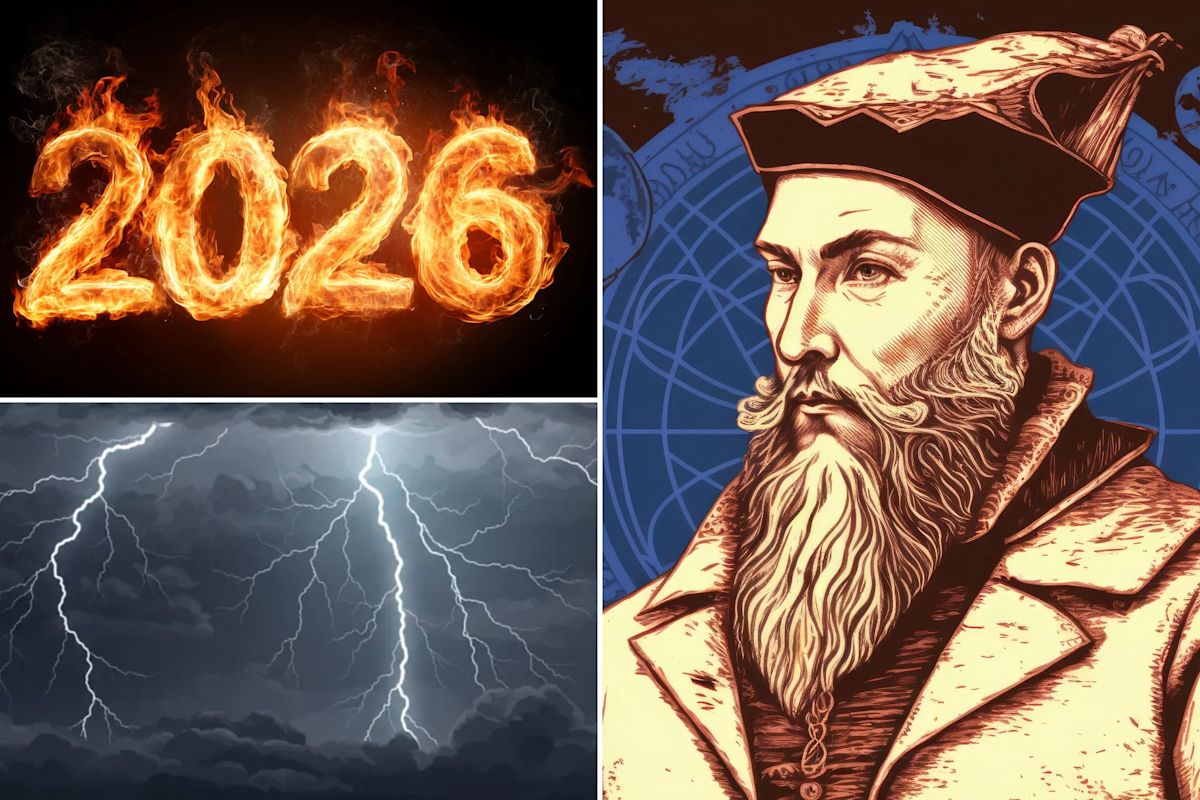
Nostradamus Predictions for November–December 2026: War, Political Upheaval, Financial Uncertainty, and Mysterious Warnings for the End of the Year
Mystery, Prophecy and World Events | November 3, 2026
As 2026 approaches its final two months, renewed interest is turning toward the writings of Michel de Nostredame, better known as Nostradamus, the 16th-century French astrologer whose mysterious writings have fascinated readers for nearly 500 years.
His collection of prophetic verses, commonly known as Les Prophéties, contains hundreds of cryptic passages describing wars, political turmoil, natural disasters, powerful leaders, and dramatic changes in society.
Some modern interpreters believe several of these writings could be connected to events unfolding during November and December 2026.
Among the subjects attracting attention are:
• Potential international conflicts and geopolitical instability.
• Political leadership changes and struggles for power.
• Financial uncertainty and economic disruption.
• Unusual weather and natural disasters.
• Unexpected developments involving science and technology.
But did Nostradamus actually identify these final two months of 2026, or are modern readers connecting centuries-old passages to current concerns?
The distinction is important. Nostradamus did not provide a verified calendar of predictions for November or December 2026. The following article examines interpretations being circulated today rather than presenting them as established forecasts.
1. A Possible Escalation of International Conflict
One of the most frequently discussed passages associated with 2026 concerns a seven-month war.
A verse attributed to Nostradamus contains references to a great war lasting seven months, widespread deaths, and the French cities of Rouen and Évreux.
Modern interpreters have connected this passage to continuing international conflicts and tensions between major world powers.
As November and December approach, some readers speculate that the verse could symbolize:
• Escalating international military tensions.
• Increased competition between global powers.
• Diplomatic breakdowns.
• Changes in military alliances.
• A prolonged conflict with consequences beyond its original region.
However, the original passage does not identify November or December 2026, nor does it identify a modern country or conflict.
Its connection to current events remains speculative.
Source: Sky HISTORY
2. Political Upheaval and the Rise of Unexpected Leaders
Another theme frequently associated with Nostradamus is the emergence of powerful leaders during periods of political uncertainty.
Some modern interpretations of his writings describe a mysterious new leader, sometimes referred to as a "man of light," who could emerge during a period of international instability.
Other readers point to his references to powerful rulers, political struggles, and changing alliances.
For November and December 2026, enthusiasts have suggested several possible interpretations:
• Unexpected political leadership changes.
• Major disagreements between world leaders.
• Shifts in international alliances.
• Public dissatisfaction with established political institutions.
• The emergence of influential political figures.
There is no reliable evidence that Nostradamus identified a particular modern politician or predicted a specific leadership change during these months.
3. Financial Instability and Economic Uncertainty
Financial uncertainty is another subject that modern prophecy enthusiasts sometimes connect to Nostradamus.
His writings contain symbolic references to wealth, conflict, scarcity, and changes in power.
Some interpreters associate these themes with possible financial instability, currency uncertainty, and economic pressure.
Potential scenarios discussed by modern commentators include:
• Volatility in global stock markets.
• Changes in the value of major currencies.
• Economic uncertainty involving government debt.
• Increased interest in gold and silver.
• Financial pressure on households and businesses.
These interpretations have particular appeal during periods of economic uncertainty.
However, there is no authenticated Nostradamus passage establishing that a financial collapse will occur in November or December 2026.
4. Natural Disasters and Unusual Weather
Nostradamus frequently used imagery involving floods, storms, fire, drought, and destruction.
Modern readers sometimes associate these passages with earthquakes, hurricanes, extreme temperatures, wildfires, and flooding.
For the final months of 2026, some interpretations suggest possible concerns involving:
• Severe storms and flooding.
• Unusual seasonal weather.
• Earthquake activity.
• Wildfires and drought conditions.
• Disruptions affecting coastal communities.
It is important to remember that these are symbolic interpretations, not meteorological predictions.
Actual weather and natural-disaster risks should be assessed through scientific monitoring and official emergency announcements.
5. The Mysterious Swarm of Bees
One of the most frequently discussed Nostradamus passages associated with 2026 refers to a great swarm of bees.
The passage has attracted attention because bees have historically been used as symbols of leadership, power, unity, and political authority.
Some modern commentators believe the imagery could represent:
• A powerful political movement.
• A sudden shift in international influence.
• A large-scale social movement.
• Unexpected developments involving prominent leaders.
The interpretation is highly uncertain. The original verse does not identify a modern political figure or specify a particular month.
Nevertheless, the unusual imagery has become one of the most recognizable themes in discussions about Nostradamus and 2026.
Source: Sky HISTORY
6. International Tensions Between East and West
Another recurring interpretation involves the changing balance of global power.
Some readers connect Nostradamus's references to eastern and western forces with contemporary geopolitical competition.
For the end of 2026, these interpretations have been associated with:
• Competition between the United States and China.
• Russia's relationship with European countries.
• International military alliances.
• Global trade disputes.
• Competition involving advanced technology.
• Diplomatic negotiations over disputed territories.
These are important contemporary geopolitical issues, but Nostradamus did not explicitly identify the modern countries involved.
7. Could a Major Scientific or Technological Discovery Change the World?
Some interpretations of Nostradamus's writings focus on discoveries, celestial phenomena, and dramatic changes in human knowledge.
Modern enthusiasts sometimes connect these themes to artificial intelligence, medical breakthroughs, space exploration, and technological developments.
As 2026 concludes, possible areas of public interest include:
• Major advances in artificial intelligence.
• New developments in space exploration.
• Scientific discoveries involving medicine.
• Changes in global communications.
• Breakthroughs in energy technology.
There is no specific authenticated passage establishing that Nostradamus predicted an AI breakthrough or a particular scientific discovery in November or December 2026.
These connections are modern interpretations rather than documented forecasts.
8. What Do the Original Writings Actually Tell Us About the End of 2026?
One important detail is that Nostradamus generally wrote in four-line verses called quatrains.
His writing used symbolism, historical references, unusual language, and imagery that can be difficult to interpret.
He did not provide a reliable month-by-month forecast for the year 2026.
Modern articles frequently select particular verses and associate them with events that are already receiving public attention.
For example, the verse about seven months of war, the swarm of bees, and references to blood in the Ticino region have all been connected to 2026 by modern interpreters.
However, the original writings do not establish that these events will happen during the final two months of the year.
Source: The Standard
Nostradamus: Themes Being Associated With November–December 2026
Subject Modern Interpretation Historical Certainty
International conflict Escalating geopolitical tensions Unverified
Political leadership Unexpected leaders and power struggles Unverified
Financial markets Economic instability Unverified
Natural disasters Floods, storms, and unusual weather Unverified
Swarm of bees Political or social movements Symbolic interpretation
East versus West Global power competition Unverified
Scientific discoveries Technological transformation Unverified
Conclusion: What Might the Final Months of 2026 Bring?
As November and December 2026 approach, Nostradamus's mysterious writings continue to attract attention from people interested in prophecy, history, and the possibility of future world events.
The most popular interpretations involve international conflict, political upheaval, economic uncertainty, natural disasters, and changing global power structures.
These subjects reflect genuine concerns in the modern world, which may explain why readers continue searching for connections between 16th-century writings and contemporary events.
But there is an important distinction between a historical prophecy and a modern interpretation.
There is no verified Nostradamus prediction specifically identifying November or December 2026 as the date of a major war, financial collapse, natural disaster, or political transformation.
Whether the final two months of 2026 bring unexpected developments or relatively ordinary events, Nostradamus's writings will likely continue generating discussion.
Perhaps the most fascinating aspect of his legacy is not whether he accurately predicted the future, but why generations of people continue finding new meanings in his mysterious words.
 103005