
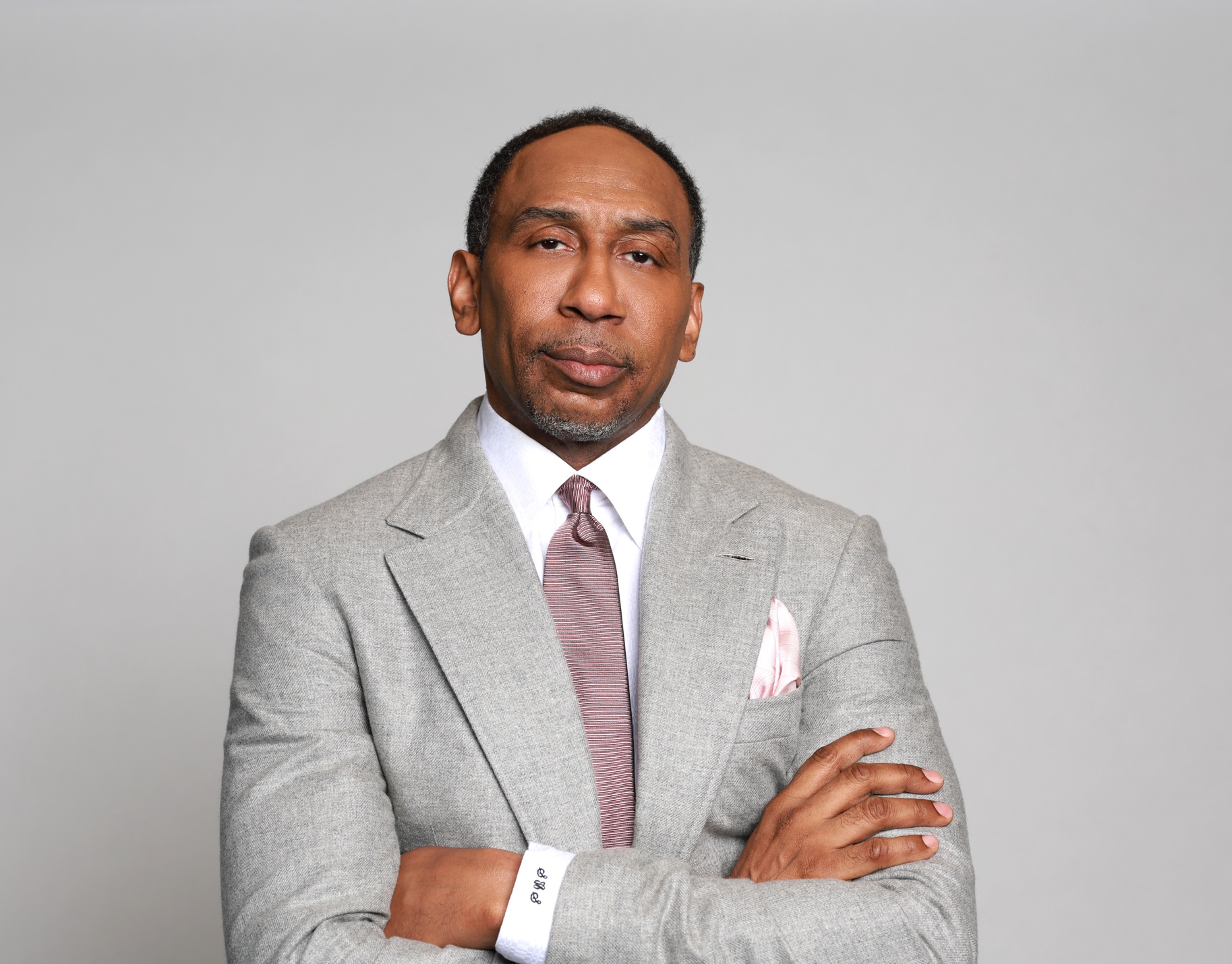
Stephen A. Smith: The Rise of a Media Powerhouse and the Debate Over His Voice in Black America
Few people in sports media have turned their voice into a brand as successfully as Stephen A. Smith.
For more than two decades, Smith has evolved from a newspaper reporter into one of the most recognizable personalities in American sports media. His voice is distinctive, his delivery is unmistakable, and his willingness to challenge athletes, executives, coaches and fellow commentators has made him a central figure in sports conversation.
But Smith's influence now extends well beyond sports.
He increasingly comments on politics, race, culture and social issues, and that expansion has created an interesting contradiction: the same qualities that made him enormously successful in sports media—his confidence, directness and willingness to say what he thinks—have also made him a polarizing figure among some members of the Black community.
That tension raises an important question: What happens when a prominent Black commentator becomes increasingly critical of some of the very athletes and cultural figures who helped define his audience?
From Newspaper Reporter to National Personality
Smith's career did not begin with television fame.
He worked as a newspaper journalist, including a lengthy tenure at the Philadelphia Inquirer, where he covered the Philadelphia 76ers and eventually became a general sports columnist. He joined ESPN in 2003 and gradually expanded his television and radio presence. ESPN Press Room
His path wasn't entirely upward.
In 2009, ESPN did not renew his contract, forcing Smith to rebuild his career elsewhere before eventually returning to the network. His comeback ultimately became one of the defining stories of his professional life. The Washington Post+1
His breakthrough came through First Take.
Smith became a full-time fixture on the program in 2012, initially sharing the debate stage with Skip Bayless. The format gave him something newspaper columns and conventional sports broadcasts could not: an enormous platform for his personality.
Instead of simply reporting what happened, Smith became part of the story.
He argued.
He challenged.
He predicted.
He criticized.
And, perhaps most importantly, he made viewers want to hear what he would say next.
The Power of the Stephen A. Brand
Smith understood something fundamental about modern media: attention is currency.
His ability to generate conversation became an asset.
ESPN ultimately rewarded that success. In 2025, the network signed Smith to a multiyear contract that would keep him at the center of First Take and across ESPN programming. ESPN described him as a "difference maker" whose sports knowledge, strong opinions and distinctive style captivated fans. ESPN Press Room
His influence has also expanded beyond traditional television.
Smith hosts his own podcast, Know Mercy with Stephen A. Smith, which covers politics, entertainment, social issues and business in addition to sports. ESPN Press Room
That expansion is significant because it means Smith is no longer merely interpreting sports.
He is increasingly interpreting society.
And the stakes are different when the subject is race, politics or identity rather than whether a quarterback should be benched.
Why His Words Carry So Much Weight
Smith's influence comes partly from his ability to turn commentary into an event.
A Smith statement can become a headline, a social-media clip, a television debate and a conversation among fans within hours.
That gives his words unusual reach.
It also creates an unusual responsibility.
When a relatively unknown commentator criticizes an athlete, the criticism may disappear quickly.
When Stephen A. Smith does it, millions of people may hear it.
That distinction is particularly important when his target is a prominent Black athlete or public figure.
His Relationship With Black Athletes
Smith has spent much of his career criticizing athletes, regardless of race.
That is fundamental to the sports-debate model.
He has challenged LeBron James, Kevin Durant, Kyrie Irving, Terrell Owens and numerous other prominent athletes. His supporters argue that criticism is part of his job and that Black athletes should not be treated as though they are beyond scrutiny simply because they are Black.
That argument has merit as a matter of journalistic principle: race should not automatically shield a public figure from legitimate criticism.
But a different criticism has emerged.
Some Black commentators argue that Smith's criticism of Black athletes can sometimes feel disproportionately personal or severe compared with his treatment of white athletes, owners, executives or other powerful figures.
Former NBA player Etan Thomas made that argument in a 2026 open letter to Smith, specifically naming several Black athletes and arguing that Smith applies a harsher standard to them. That is Thomas's interpretation, not an established measurement of Smith's overall commentary. The Guardian
The disagreement therefore isn't necessarily about whether Smith should criticize Black athletes.
It is about how he criticizes them and whether the standards are consistent.
Accountability or Disproportionate Criticism?
This is where the debate becomes more complicated.
Smith has built his reputation around accountability.
He frequently argues that professional athletes are paid enormous amounts of money and therefore should be prepared to accept enormous scrutiny.
That philosophy can be applied consistently across racial lines.
But some members of the Black community see an additional responsibility when a prominent Black commentator speaks about Black athletes.
They ask whether criticism should account for the broader racial environment in which Black athletes operate.
Others reject that premise.
They argue that treating Black athletes differently—even if the intention is protective—can become a form of lowered expectations.
That creates a genuine philosophical disagreement.
One side emphasizes representation and solidarity.
The other emphasizes accountability and individual responsibility.
Smith's commentary frequently lands directly in the middle of that debate.
His Views on Black America Have Expanded Beyond Sports
The controversy surrounding Smith became more pronounced as he expanded into political commentary.
In 2026, he argued that Black voters should seriously consider voting Republican rather than assuming continued support for Democrats. He has also criticized Democratic politicians and questioned what he sees as the Democratic Party's assumption that Black voters will remain loyal. The Guardian+1
Smith's argument is essentially that Black voters should demand more from politicians rather than automatically supporting one party.
Supporters can interpret that as an argument for political independence.
Critics, however, have argued that his framing ignores or minimizes historical and contemporary concerns that influence Black voters' political choices. Thomas, for example, strongly challenged Smith's political arguments and accused him of applying a different standard to Black voters than to other groups. The Guardian
Again, the disagreement is not simply about party politics.
It is about how Smith believes Black Americans should think about political power.
Why Some Black Americans Feel Divided Over Him
It would be inaccurate to describe Black America as having a single opinion of Stephen A. Smith.
There is no monolithic Black political or cultural perspective.
Smith has significant support among Black viewers, and he has also attracted criticism from Black athletes, journalists, commentators and activists.
That division is part of what makes his position so interesting.
He represents a generation of Black media personalities who have achieved enormous professional success while operating within predominantly corporate media institutions.
For some, that makes Smith an example of Black excellence and professional independence.
For others, his willingness to criticize Black athletes and public figures creates a sense that he is sometimes too eager to challenge people from his own community.
Neither interpretation represents the entirety of Black public opinion.
His Relationship With Black Institutions
The tension reached another level in 2026 when the National Association of Black Journalists gave Smith its "Thumbs Down" award.
The organization criticized what it described as a recurring pattern of disparaging commentary toward prominent Black women in politics, sports and media.
Smith responded forcefully, saying he had supported Black women throughout his career and objecting to the organization's decision. Los Angeles Times+1
The dispute is revealing because both sides are invoking accountability.
NABJ is arguing that a prominent Black journalist has a responsibility to avoid reinforcing harmful portrayals.
Smith is essentially arguing that Black journalists should be allowed to criticize members of their own community without being accused of betraying it.
That tension is unlikely to disappear.
His Record of Supporting Black Institutions Matters Too
It is important not to discuss Smith solely through his controversies.
He has also made significant efforts to support Black educational institutions.
Smith attended Winston-Salem State University, an HBCU, and has maintained a visible relationship with historically Black colleges and universities. ESPN notes that his involvement with the HBCU College Fair included helping bring national attention to the event; the event has provided substantial scholarship opportunities for students. ESPN Press Room
That complicates the idea that Smith simply does not care about Black communities.
His record contains both advocacy and criticism.
That is perhaps the fairest way to understand him.
Why His Words Have Become So Powerful
The modern media environment rewards people who can create conversation.
Smith is exceptionally effective at doing that.
He understands television, social media, headlines and controversy. He understands that viewers don't simply want information—they want interpretation.
His greatest strength is therefore also his greatest source of controversy.
He rarely speaks timidly.
When he believes something, he tends to make his position unmistakable.
That makes him compelling.
It also means that when he gets something wrong, says something poorly, or appears to apply inconsistent standards, the consequences can be much larger.
The Evolution of Stephen A. Smith
Perhaps the most interesting part of Smith's career is that he has evolved.
The man who once primarily argued about basketball now talks about presidential politics, race, culture, business and American society.
That evolution creates opportunities but also risks.
Sports arguments are comparatively contained.
Political and racial arguments are not.
A debate about whether LeBron James should take the final shot can generate disagreement.
A debate about how Black Americans should vote touches history, identity, economics and civil rights.
The latter requires a different level of context.
A Voice That Refuses to Be Easily Defined
One reason Smith remains difficult to categorize is that he doesn't fit neatly into a conventional political or cultural box.
He has criticized Democrats.
He has criticized Republicans.
He has criticized Black athletes.
He has criticized white athletes.
He has criticized media organizations.
He has criticized corporate executives.
He has also defended people and causes that he believes deserve support.
That independence is part of his appeal.
It is also part of the reason different audiences can interpret the same statement in completely different ways.
One person hears independence.
Another hears inconsistency.
One hears accountability.
Another hears disrespect.
One hears a Black commentator challenging his own community.
Another hears someone unfairly targeting it.
The Larger Question
The larger issue surrounding Stephen A. Smith may not actually be whether he is right or wrong.
It is whether Black public figures should be expected to exercise a different kind of responsibility when speaking about their own community.
Smith appears to believe that Black athletes, politicians and entertainers should be held to the same—or perhaps even higher—standards of accountability as everyone else.
His critics argue that accountability without sufficient attention to context can become unfair criticism.
Both ideas can exist simultaneously.
A person can believe Black public figures deserve accountability while also believing that the people delivering that criticism should examine their own standards.
That is the unresolved tension surrounding Smith.
Conclusion
Stephen A. Smith's rise is remarkable.
He went from newspaper reporter to one of the most recognizable voices in American sports media. He survived a career setback at ESPN, returned to television, became the face of First Take, expanded into podcasts and cultural commentary, and secured a long-term position as one of the industry's most powerful personalities. ESPN Press Room+1
But his greatest impact may ultimately have little to do with sports.
Smith has become part of a larger conversation about Black identity, accountability, representation and political independence.
His willingness to criticize Black athletes and politicians has earned both admiration and criticism within Black America. Some see an independent voice unwilling to protect people simply because they share his racial identity. Others believehis criticism can cross into unfairness or reinforce negative narratives about Black public figures.
That division is real, but it is also important not to mistake disagreement among prominent commentators for a single view held by an entire ethnic or racial community.
Perhaps the most revealing thing about Stephen A. Smith is that he has become successful enough that his opinions are no longer simply sports commentary.
They have become part of the national conversation.
And when someone possesses that much influence, the debate over what he says—and why he says it—is almost inevitable.
 189037