NewStori...First & Foremost A Quality News Outlet!
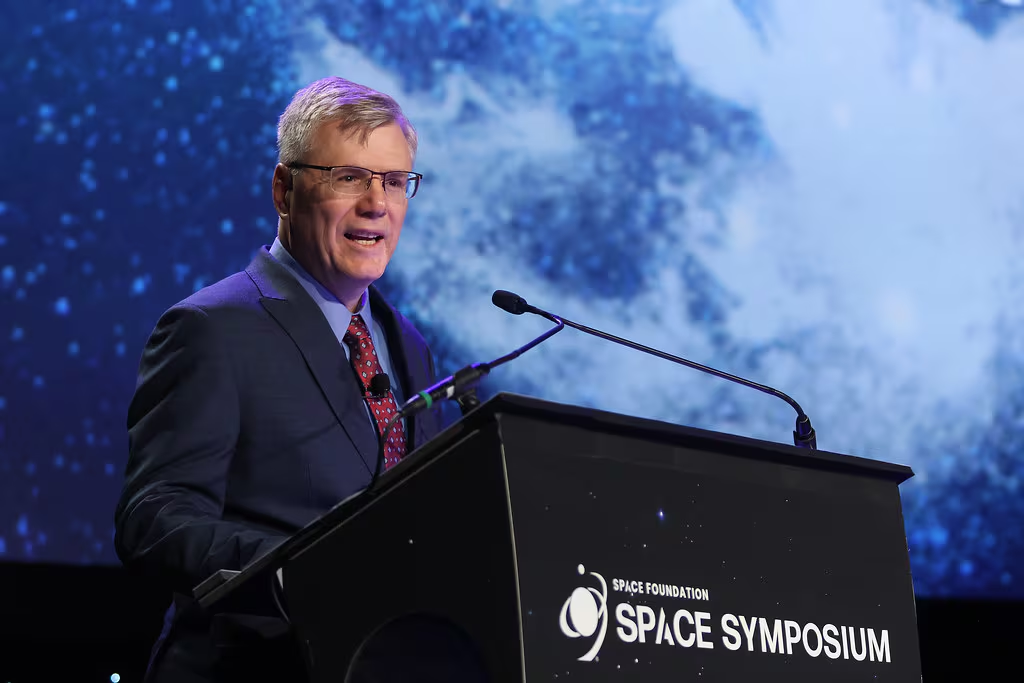
Among the resumes of President-elect Donald Trump’s picks for key Pentagon posts, aspiring Air Force secretary Troy Meink’s stands out.
As a Defense Department insider with deep acquisition and technology-development experience, Meink would bring to the job a government background unlike that of Trump’s other DOD nominees. And his specialization in space could upend the priorities of a service typically dominated by Air Force interests.
Todd Harrison, a senior defense policy fellow at the American Enterprise Institute, said choosing a space expert like Meink to lead the Air Force is “consequential” and indicates that space will be a high priority under the Trump administration.
“He is solidly from a space background, unlike any other secretary of the Air Force,” Harrison told Defense News. “I think that it must be intended to send a message that the Trump administration means business when it comes to the Space Force and the prioritization of the Space Force.”
In Meink’s current role as deputy director of the National Reconnaissance Office, or NRO, he oversees the day-to-day operations of the spy agency, which provides space-based intelligence to the military. Throughout his career, he’s held positions in the Air Force space community, including stints at the Air Force Space and Missile Systems Center and in the office of the deputy undersecretary of the Air Force for space.
If confirmed, Meink will lead the Air Force and the Space Force at a time when both services face important decisions about the size and shape of their future force. For the Air Force, that means designing a next-generation fighter fleet, modernizing two legs of the nuclear triad and determining how to integrate more autonomy and uncrewed aircraft across its portfolio.
Meanwhile, the Space Force – which was created five years ago under the first Trump administration – is looking to double or triple its budget in the coming years to get after growing threats and new missions alike.
The next Air Force secretary will decide how resources are distributed between the two services, and a leader with Meink’s space expertise could shift more funding toward the Space Force, whose $30 billion budget for fiscal 2025 is a fraction of the Air Force’s $188 billion request.
“The airpower advocates out there are probably very worried about this pick because we’re in an era where the budget is not growing,” Harrison said. “If the Space Force is going to grow in priority and grow in funding, that may very well come at the expense of the Air Force.”
Harrison noted that Meink will also inherit decisions around how to transition missions, such as moving target indication — typically performed from the air — to space sensors and satellites.
“I think he will bring, perhaps, a preference or a healthy kind of new perspective on the trade-offs between air and space,” he said. “There are a number of mission areas that are ripe to move from the Air Force side to the Space Force side. Some of that’s already starting to happen, some of it could be accelerated.”
During Meink’s tenure at the NRO, the largely classified agency’s public-facing successes have included launching more than 100 ISR satellites as part of a proliferated constellation in low Earth orbit and partnering more closely with commercial companies for satellite imagery and other services.
Kari Bingen, director of the Aerospace Security Project at the Center for Strategic and International Studies and principal deputy undersecretary for intelligence during Trump’s first term, said Meink has been at the leading edge of advancing data processing and analytic capabilities — an expertise that will serve both the Air Force and the Space Force well.
“He grounds himself in technical facts and analysis,” she said. “Whether it’s a space issue or an air issue, he’s going to approach it thoughtfully and substantively.”
Meink’s NRO background also will likely inform his perspective on the distinct roles and responsibilities of the Space Force and the intelligence community — a sometimes heated topic as the service takes on new missions. The first Trump administration pushed for greater collaboration between the organizations and even proposed consolidating the NRO under the Space Force.
Doug Loverro, a former Pentagon space policy official, said Meink’s experience could help smooth out some of those discussions.
“This helps make that process work better because now you’ll have somebody who understands both sides equally well,” he said.
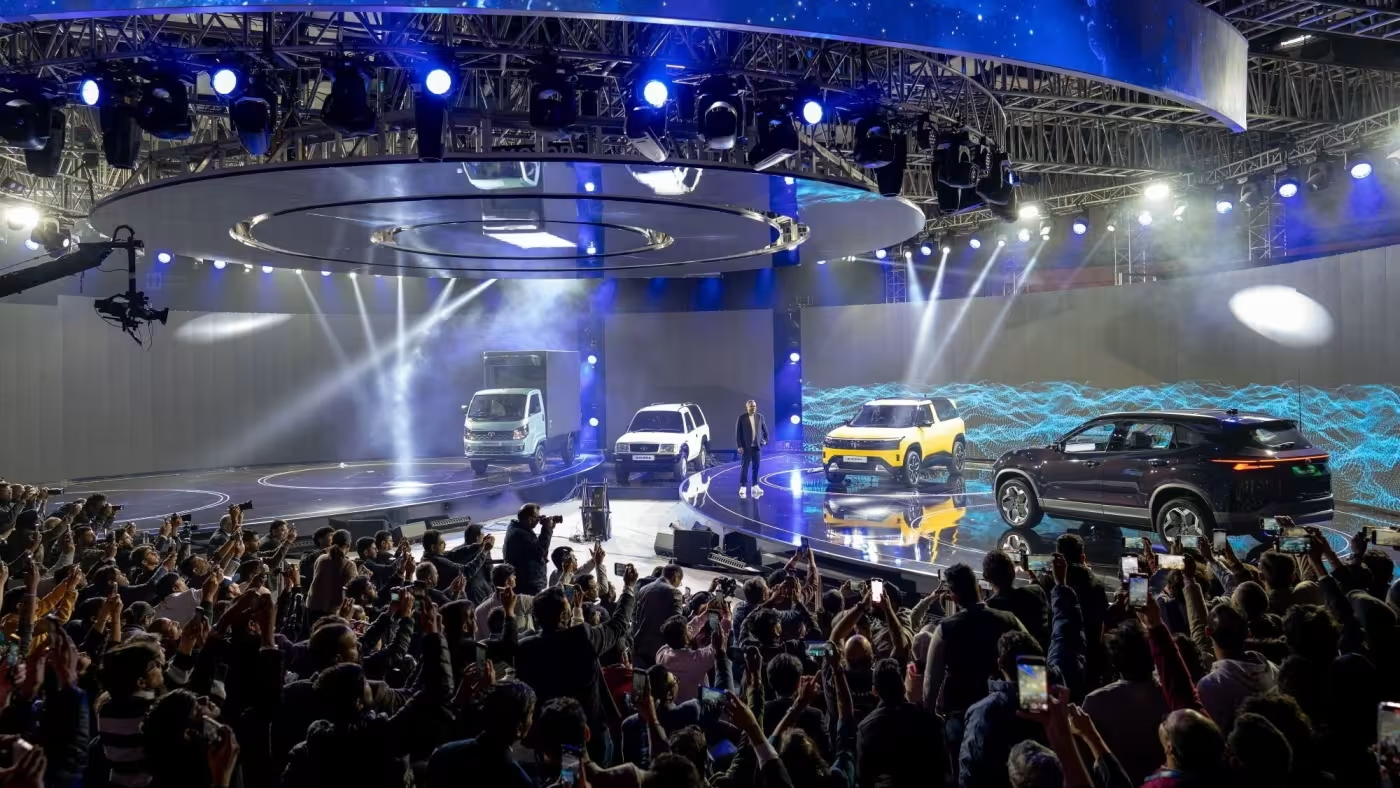
Electric vehicles are getting a big push at this year’s Bharat Mobility Global Expo (previously, auto expo). The Indian auto industry’s biggest show kicked off with the prime minister on Friday making the case for “economy and ecology”, highlighting the government’s focus on the development of green technologies and reducing the import bill for fossil fuels.
In March 2024, the government unveiled policies aimed at promoting India as a manufacturing destination for EVs. Companies investing $500mn in production facilities in the country are allowed to import electric cars as “completely knocked down kits” (where all the parts of the car are imported and assembled locally) at a reduced customs duty of 15 per cent (from 70 per cent) for five years. Many Indian states have also announced their own incentive schemes for EV manufacturers.
Over the weekend, several companies unveiled their EV offerings for India. Chinese carmaker BYD launched its electric sport utility vehicle, Sealion 7; Vietnam’s VinFast announced it would be launching two electric SUVs later this year; and homegrown Maruti Suzuki launched an electric version of its Vitara model, among others.
While two and three-wheelers have witnessed consumer enthusiasm, the same cannot be said for cars. The government is hoping EVs will constitute 30 per cent of passenger cars in India by 2030, but they only have about 2 per cent market share now.
Battery life and charging infrastructure continue to be a significant problem. It takes nearly a day to charge a car from an AC socket. While companies do install wall box chargers, they are often vulnerable to theft. In urban India’s unpredictable traffic and road conditions, range anxiety is a real issue. Access to charging points on highways is almost non-existent, making EVs a consideration for a second car in the household at best.
This is a bit of a chicken and egg situation for the industry. Car sales have to cross a certain threshold for manufacturers to invest more in the charging infrastructure but the poor charging infrastructure is a deterrent for higher sales. Indian customers are still following a wait and watch approach. While the government’s EV push for manufacturing will drive investment and employment, it should also augment the charging infrastructure in order to make private investments in manufacturing a feasible option.