NewStori...First & Foremost A Quality News Outlet!
Silver and platinum plunged, extending a recent run of exceptional volatility as traders weighed index rebalancing sales, supply constraints and the risk of potential US tariffs. Gold also declined.
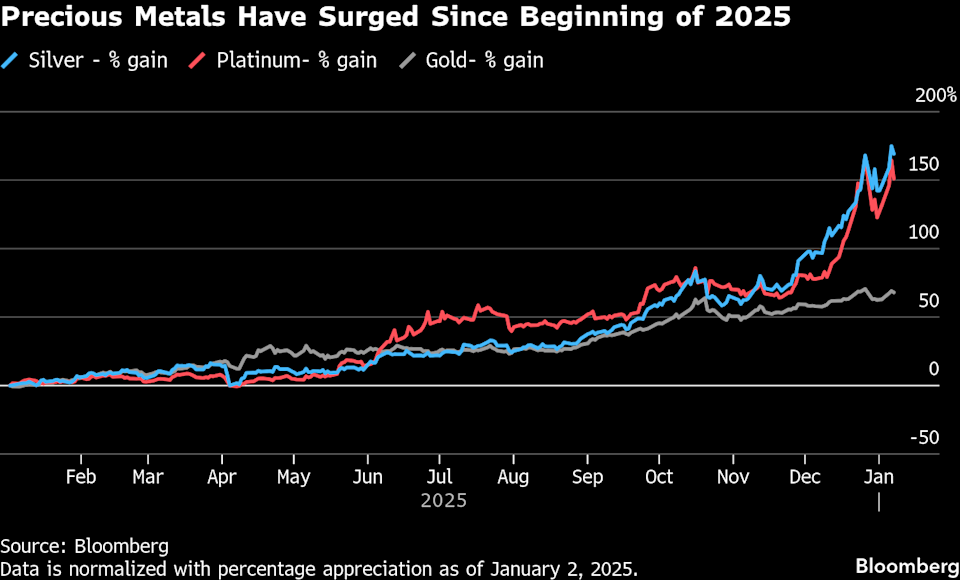
Spot platinum slid as much as 7.7% and silver tumbled as much as 6%, though both metals are still up for the month so far. Silver had powered to a record high above $84 an ounce in late December as strong retail investor appetite, particularly in China, buffeted prices in thin trading over the holiday period.
Gold and palladium also fell alongside their precious metal peers ahead of an annual rebalancing of broad commodity indexes, which sometimes are a drag on prices because passive tracking funds sell commodities that have rallied heavily to match new weightings.
“We expect large-scale selling activity to kick off amid significant rebalancing flows from broad commodity indices,” TD Securities strategist Daniel Ghali wrote in a note, adding that silver had seen a “devilish blow-off top.”
Citigroup Inc. has estimated outflows of $6.8 billion from gold futures contracts and roughly the same amount from silver because of reweighting of the two largest commodity indexes that’s set to start this week.
Both metals faced a similar index selloff last year, without causing a discernible drag on the market, according to a Dec. 12 note from JPMorgan Chase & Co. The bank, however, said the amount of selling required in silver is more outsized this year.
In the London market, the dominant spot-trading hub, silver and platinum supplies have been tight following shipments to the US last year spurred by tariff fears. Borrowing costs for the metals eased somewhat this week, but still remain historically elevated as inventories remain locked in US warehouses.
Traders are awaiting the outcome of Washington’s Section 232 probe into imports of critical minerals that could lead to levies or trade restrictions.
“You now have a lack of liquidity that means that anyone who wants to come into the market really has to pay up for that,” Michael Widmer, head of metals research at Bank of America Corp., told Bloomberg Television. While there’s a positive fundamental demand outlook for silver, which has many industrial applications, speculators have brought excessive volatility into the market, he said.
Traders also are keeping an eye on geopolitical tensions that may bolster haven demand. Days after the seizure of Venezuela’s president, the White House refused to rule out military force to acquire Greenland. China, meanwhile, imposed controls on exports to Japan with any military use.
While the geopolitical landscape remains fragile, traders are turning their attention to a busy lineup of US economic data, including the December jobs report due Friday. November’s report showed job openings fell to a more than one-year low and hiring slowed, bolstering hopes for more interest rate cuts by the US Federal Reserve amid signs of a softening labor market.
Adding to these expectations, Fed Governor Stephen Miran said the central bank would need to cut rates by more than a percentage point in 2026, telling Fox Business Network that monetary policy is restraining the economy. Three successive rate cuts in 2026 were a tailwind for precious metals, which don’t pay interest.
Gold is fresh from posting its best annual performance since 1979, hitting a series of record highs last year with support from central-bank buying and inflows to bullion-backed exchange-traded funds. Silver’s rally was even more spectacular, with prices surging nearly 150% as the metal benefited from the supply tightness and the possibility of tariffs.
Spot silver dropped 3.7% to $78.2564 an ounce as of 4:03 p.m. in New York. Spot gold was down 0.9% at $4,453.98 an ounce. Platinum slid 5.8% to $2,303.73 an ounce, while palladium lost 3.5%. The Bloomberg Dollar Spot Index was up 0.1%.
As exchange-traded funds (ETFs) continue to gain popularity among individual and institutional investors, understanding how to navigate the expanding ETF landscape has become essential. With thousands of products now available across global markets, ETFs offer access to stocks, bonds, commodities, and specialized strategies—but choosing the right ones requires a clear roadmap.
ETFs are investment funds that trade on stock exchanges like individual shares, typically tracking an index, sector, commodity, or theme. Their appeal lies in their simplicity, transparency, and generally lower costs compared with traditional mutual funds. Over the past decade, ETFs have transformed how investors build diversified portfolios, enabling broad market exposure with a single trade.
Understanding the Core ETF Categories
The ETF universe can be broadly divided into several categories. Equity ETFs track stock indices ranging from broad benchmarks like the S&P 500 to specific regions, sectors, or market capitalizations. Fixed-income ETFs provide exposure to government bonds, corporate debt, or high-yield securities, often appealing to income-focused or risk-conscious investors.
Beyond traditional asset classes, commodity ETFs allow investors to gain exposure to gold, silver, oil, or agricultural products without directly holding physical assets. Thematic and sector ETFs target trends such as clean energy, artificial intelligence, healthcare innovation, or emerging markets, reflecting growing demand for targeted investment strategies.
Passive vs. Active ETFs
Most ETFs are passively managed, designed to replicate the performance of an index at minimal cost. However, actively managed ETFs have grown rapidly, with portfolio managers making discretionary decisions to outperform benchmarks or manage risk. While active ETFs often carry higher fees, they appeal to investors seeking flexibility and professional oversight within the ETF structure.
Key Factors Investors Should Consider
A practical ETF roadmap begins with understanding investment objectives and risk tolerance. Expense ratios, tracking error, liquidity, and underlying holdings are critical factors when evaluating ETFs. Lower-cost ETFs tend to perform better over time, all else being equal, while high trading volume can reduce bid-ask spreads and improve execution.
Investors are also encouraged to look beyond an ETF’s name or theme and examine its holdings closely. Two ETFs with similar labels may have significantly different exposures, weightings, and risk profiles.
ETFs in a Changing Market Environment
Recent market volatility, shifting interest rates, and evolving economic conditions have increased demand for ETFs as flexible portfolio tools. Investors are using bond ETFs to manage duration risk, commodity ETFs as inflation hedges, and diversified equity ETFs to maintain broad market exposure amid uncertainty.
Regulatory developments and product innovation continue to expand the ETF landscape, with new offerings focused on sustainability, factor investing, and alternative strategies. While these products can offer unique opportunities, they may also introduce complexity and higher risk.
A Tool, Not a Shortcut
Financial advisors emphasize that ETFs are powerful tools—but not shortcuts to guaranteed returns. Like all investments, ETFs carry risk, and performance depends on market conditions and investor discipline. Building a well-balanced portfolio often involves combining multiple ETFs across asset classes and rebalancing over time.
As ETFs become an increasingly central part of modern investing, a clear guide—grounded in fundamentals, costs, and long-term goals—can help investors navigate the crowded marketplace with confidence. For those willing to do their homework, ETFs offer a versatile roadmap for participating in global markets while maintaining control, transparency, and efficiency.