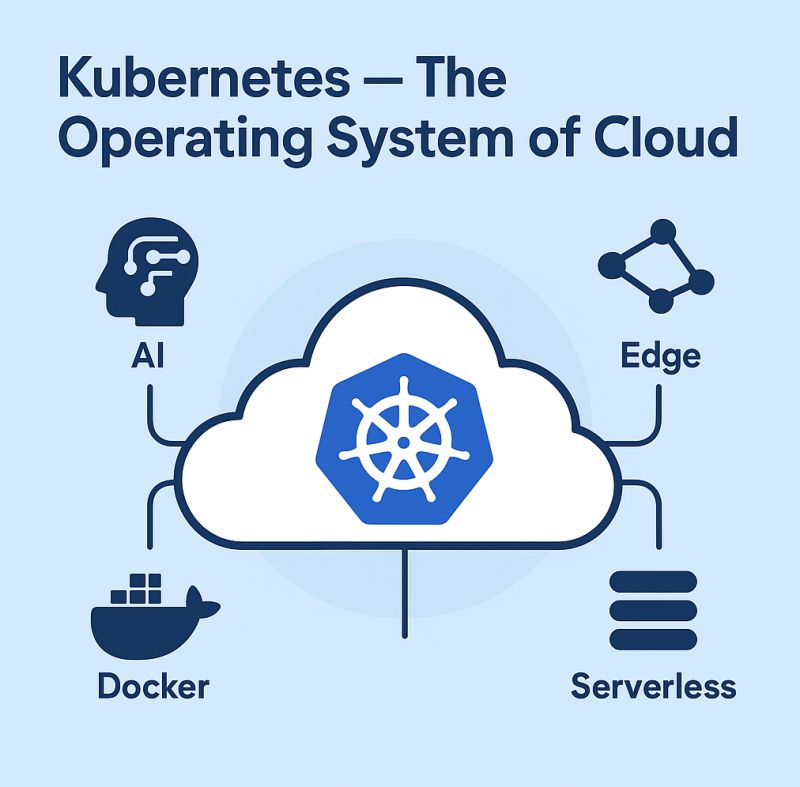
Inside Kubernetes: A Microbook on Architecture, Core Technologies, Challenges, and Troubleshooting
Chapter 1: What Kubernetes Is and Why It Exists
Kubernetes (K8s) is an open-source container orchestration platform designed to automate the deployment, scaling, and management of containerized applications.
Originally developed at Google and now maintained by the Cloud Native Computing Foundation (CNCF), Kubernetes solves a core problem: how to reliably run distributed applications at scale.
Kubernetes abstracts infrastructure complexity and provides a consistent platform across on-premise, cloud, and hybrid environments.
Chapter 2: Core Architectural Components
Kubernetes uses a control plane + worker node architecture.
1. Control Plane
The control plane makes global decisions about the cluster.
Key components:
• kube-apiserver – the front door to the cluster
• etcd – distributed key-value store
• kube-scheduler – assigns pods to nodes
• kube-controller-manager – reconciles desired state
• cloud-controller-manager – integrates cloud services
2. Worker Nodes
Worker nodes run application workloads.
Key components:
• kubelet – node agent managing pods
• container runtime – containerd or CRI-O
• kube-proxy – networking and service routing
Chapter 3: Containers and Runtime Technologies
1. Containers
Kubernetes orchestrates containers built with:
• Docker (historically)
• OCI-compliant runtimes
Containers provide:
• Process isolation
• Image-based deployments
• Fast startup and teardown
2. Container Runtime Interface (CRI)
CRI allows Kubernetes to work with multiple runtimes.
Popular runtimes:
• containerd
• CRI-O
This abstraction keeps Kubernetes flexible and modular.
Chapter 4: Networking in Kubernetes
Kubernetes networking is powered by Container Network Interface (CNI) plugins.
Key requirements:
• Every pod gets a unique IP
• Pods can communicate without NAT
• Services provide stable virtual IPs
Popular CNI plugins:
• Calico
• Cilium
• Flannel
• Weave Net
Other networking features:
• Services (ClusterIP, NodePort, LoadBalancer)
• Ingress controllers
• Network policies
Chapter 5: Storage and Persistence
Kubernetes decouples storage using:
• Persistent Volumes (PV)
• Persistent Volume Claims (PVC)
• StorageClasses
Supports:
• Local storage
• Network storage
• Cloud block/file storage
The Container Storage Interface (CSI) enables vendor-neutral storage integration.
Chapter 6: Scheduling, Scaling, and Automation
Key automation features:
• Deployments – declarative app management
• ReplicaSets – pod replication
• Horizontal Pod Autoscaler (HPA) – scale based on metrics
• Vertical Pod Autoscaler (VPA)
• StatefulSets – ordered, persistent workloads
• DaemonSets – one pod per node
Kubernetes uses a desired-state reconciliation model to self-heal applications.
Chapter 7: Security Technologies
Kubernetes security is multi-layered:
• RBAC – role-based access control
• Authentication – certs, OIDC, tokens
• Authorization – policies and roles
• Secrets – encrypted configuration
• Pod Security Standards
• Network Policies
• Admission Controllers
Security must be designed in—not added later.
Chapter 8: Common Issues and Challenges
1. Steep Learning Curve
• Many abstractions
• YAML complexity
2. Networking Failures
• CNI misconfigurations
• DNS resolution issues
3. Resource Mismanagement
• Incorrect CPU/memory requests
• Node overcommitment
4. Pod Scheduling Problems
• Insufficient resources
• Node taints and tolerations
5. etcd Failures
• Corruption
• Performance bottlenecks
6. Security Misconfigurations
• Over-permissive RBAC
• Exposed services
Chapter 9: Troubleshooting Kubernetes
Step 1: Inspect Pod Status
kubectl get pods
kubectl describe pod
Step 2: Check Logs
kubectl logs
kubectl logs
Step 3: Examine Events
kubectl get events --sort-by=.metadata.creationTimestamp
Step 4: Debug Networking
• Test DNS: nslookup, dig
• Verify service endpoints
• Check CNI pod health
Step 5: Validate Resource Usage
kubectl top pods
kubectl top nodes
Chapter 10: Best Practices
• Use declarative YAML
• Set resource requests and limits
• Enable monitoring and logging
• Back up etcd regularly
• Apply least-privilege RBAC
• Use namespaces for isolation
• Automate with GitOps
Chapter 11: Observability and Tooling
Common Kubernetes tools:
• Prometheus
• Grafana
• Fluent Bit / Fluentd
• Jaeger
• Helm
• Kustomize
• Argo CD / Flux
Chapter 12: Learning & Help Resources
Official Documentation
• Kubernetes Docs
https://kubernetes.io/docs/
CNCF
• Cloud Native Landscape
https://landscape.cncf.io/
Hands-On Learning
• Kubernetes Tutorials
https://kubernetes.io/docs/tutorials/
• Katacoda / Killercoda
Community
• Kubernetes Slack
https://slack.k8s.io/
• Stack Overflow (kubernetes tag)
• GitHub
https://github.com/kubernetes/kubernetes
Books & Blogs
• Kubernetes Blog
https://kubernetes.io/blog/
• CNCF Blog
Conclusion
Kubernetes is a powerful orchestration platform built on modular, open standards and distributed systems principles. Its strengths—scalability, resilience, and portability—also introduce operational complexity.
By understanding Kubernetes’ core technologies, common failure modes, and troubleshooting workflows, teams can build platforms that are resilient, secure, and cloud-native by design.
 5353
5353