NewStori...First & Foremost A Quality News Outlet!
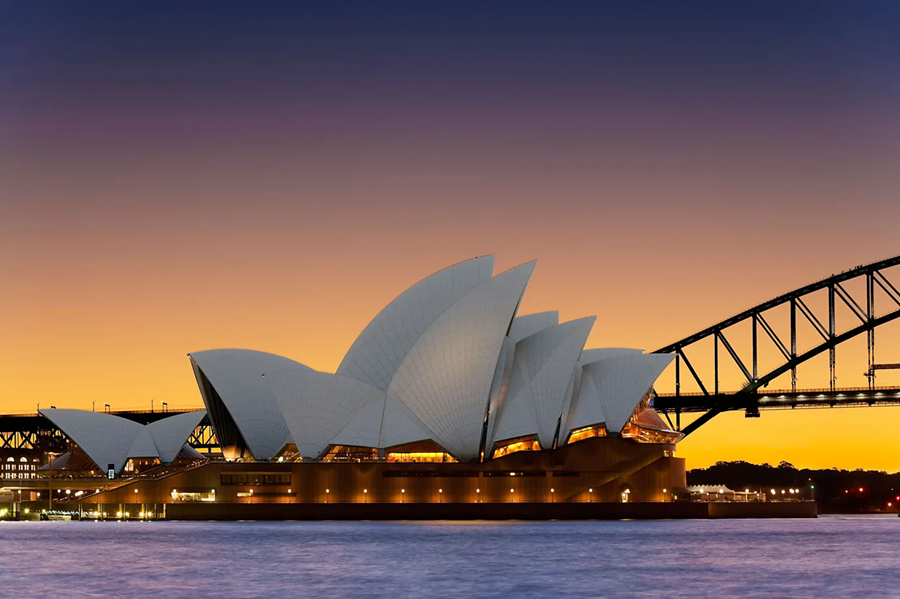
The building of the Sydney Opera House began on 2 March 1959. But when BBC Tonight visited the construction site in 1965, it was plagued by technical problems, soaring costs, vacillating public opinion and political infighting.
In 1965, BBC reporter Trevor Philpott sat overlooking Sydney Harbour as he tried to find the right metaphor to describe the vibrant, arching structures of Jørn Utzon's roof design for the Australian city's Opera House. "It was a score of towering shells. It was a cluster of seagulls spreading concrete wings. It was a huddle of sailing boats with billowing concrete sails," said Philpott. He then added the caveat: "And it was an unmitigated bitch to build."
The fraught saga of the Sydney Opera House's construction began on 2 March 1959, 66 years ago this week. Six years after that, when BBC Tonight's Philpott went to see the building's progress, it was already years behind schedule, mired in spiralling costs, changing designs and escalating political tensions. To say it was having a difficult birth would be an understatement.
The idea to build an opera house for the city had been proposed in the late 1940s by an acclaimed English conductor, Sir Eugene Goossens. At the time, Goossens was something of a celebrity in the classical music world, having carved out a successful career in the UK and the US. After World War Two, he had been lured to Sydney to become the director of the New South Wales State Conservatorium of Music with the promise of a salary greater than that of the Australian Prime Minister, musicologist Dr Drew Crawford told the BBC podcast A Very Australian Scandal in 2023.
The creation of a new, world-class music performance venue was the conductor's passion project. He had spied from his office window what he believed was the ideal site for it – the tram depot at Bennelong Point. Known to the local indigenous Gadigal people of the Eora nation as Tubowgule, it was a place where Aboriginal celebrations had been held for thousands of years. Throughout the 1950s, Goossens lobbied hard, trying to turn his dream into a reality. "There were very few other people who could have that vision, articulate that vision, and have the ear of the Premier [of New South Wales], have the ear of the Prime Minister, be able to talk to people to get it going," said Dr Crawford.
Goossens convinced the Premier of New South Wales, Joseph Cahill, that an opera house would reshape the world's view of Australia, that he had found the perfect site for it, and that they should launch "a grand competition, open to the architects of all the world, to decide exactly what manner of a building they should put there", said Philpott. "They made only one condition, that nothing quite so remarkable should have been ever built before."
Goossens himself would not get to see his ambition realised. In 1956, having just picked up his knighthood in the UK, he was detained upon his entry back into Australia, where his bags were searched and found to contain, among other things, smuggled pornography, compromising photographs and rubber masks. The resulting scandal, which involved affairs, erotica and witchcraft, completely scuppered the conductor's career in Sydney. He fled the country for Rome, traveling under the alias of Mr E Gray, never to return.
However, the design competition went ahead as planned, with a panel of judges evaluating some 233 submitted entries. At the start 1957, the government announced that a largely unknown Danish architect, Utzon, was the unexpected winner. Part of the surprise at Utzon's success was that his entry had largely consisted of preliminary sketches and concept drawings. "As far as building anything of any scale, he hadn't really done very much," Sir Jack Zunz, who worked on the project for the civil engineering firm Arup, told BBC Witness History in 2018.
An optimistic start
The judges' choice of Utzon's bold and imaginative design was not without controversy. "From the first, it stirred the people of Sydney to breathless wonder and scalding abuse," said Philpott. "It was called the Sydney Harbour monster, a piece of Danish pastry, a disintegrating circus tent."
Premier Cahill, worried that the project might be derailed by adverse public opinion or political opposition, pushed for construction work to start early. This was despite the fact that Utzon was still finalising the building's actual design, and had yet to resolve critical structural issues. Although Utzon's design was thought to be one of the cheapest, there were still problems raising money for it, so a State Lottery was launched in 1957 to help fund the project.
The initial estimate of the final cost of the Sydney Opera House was put at A£3.5m or A$7m – at the time, Australia's official currency was the pound, but was replaced by the dollar in 1966. The building was set to open on 26 January 1963: Australia Day. Both of these predictions would prove to be wildly and hopelessly optimistic. "Right from the beginning, the house was full of trouble: human, mechanical, structural," reported Philpott.
The building of the Opera House was divided into three distinct phases: construction of the podium, the roof shells, and the interior. Cahill, having persuaded the Minister of Transport to agree to the tram depot being demolished to build the podium, "found the site was neither big enough nor strong enough to carry that structure that seemed on paper light enough to fly away," said Philpott.
To bear the weight of the Opera House, the whole site needed to be extended and reinforced by driving over 550 steel-cased concrete shafts, each three feet in diameter, into land in and around Sydney Harbour. This extensive work, which had not been accounted for in either the construction's budget or its timescale, dragged on, hampered by bad weather. The podium would only be completed in January 1963 – the original date for when the Opera House was meant to open.
But this would merely be the first of the project's delays and eye-watering extra costs. The Opera House's most distinctive feature, its roof shells which mimicked a ship's sails, were to present a whole other set of engineering headaches. Initially, the plan had been to make the roof out of steel coated with concrete. However, that design presented unwelcome noise problems for any performance taking place. "The Opera House stars would have been singing above the sirens of the tugboats on the water outside, and the temperature variations would have caused the metal and concrete to rumble and crack like tropical thunder," said Philpott.
An unbuildable building
Nobody had also fully understood the scale of the engineering challenge that the Opera House's daring curved roof surfaces presented. Since Utzon's entry lacked detailed engineering plans, civil engineering firm Arup had been brought in to work out how to construct the roof's complex shell structure. But despite trying multiple different redesigns, they could not make the structural calculations add up. "The first thing Arup did when they were asked to collaborate, they took these free shapes and developed a series of mathematical models which, near as possible, matched Utzon's competition design. None of these shapes appeared buildable," Zunz told BBC Witness History.
Another issue was that, because the roof was curved, each concrete rib that supported it would be different. That meant that instead of having just one mould that could be reused to cast all the supporting beams, each individual rib would need a separate one. This was prohibitively expensive.
The answer, Utzon would later claim, came to him while he was peeling an orange. The architect realised that all segments of the roof could come from the geometry of a single sphere. By identifying which part of the sphere best suited the shapes they needed, a series of triangles each with one curved side could be cut from it, creating a variety of shells. These spherical shell segments could be broken down into individual components, which could be uniformly pre-cast in concrete and assembled onsite. "He came back a week later and said, 'I've solved it.' And he made the scheme out of a sphere," said Arup's Zunz. "But in so doing, he had changed the architecture quite radically."
This elegant solution simplified the roof's construction and reduced waste, enabling the building of the vaulted roof to begin in 1963. But as the contractors worked on executing Utzon's vision, the project was dogged by labour disputes, design changes and rising material costs, making its budget balloon and its potential completion date disappear into the distance. "By 1962, the cost had risen to A£12.5m, and now everybody admitted they were only guessing," said Philpott. "The opening day was postponed and postponed again. It had been planned for Australia Day 1963, it was put off until early 1964, then until sometime in 1966, and now no one is bold enough even to predict the year the doors may eventually open."
The project's biggest government supporter, Premier Cahill, had taken ill just months after building work had started. On his deathbed in 1959, he had made his Minister for Public Works, Norman Ryan, promise not to let the Opera House fail. Ryan, when interviewed by the BBC's Philpott in 1965, gamely made a spirited defence of the project, but by this time frustration with its mounting costs and endless delays was palpable. "I wasn't sure whether to admit to working on it at the time," admitted Zunz. "If you went into a taxi, you got an earful of all the money that was being wasted, and God knows what."
Adding to this contentious atmosphere, a few months after Ryan's BBC interview, Robert Askin, who had vocally opposed the project, was elected the New South Wales Premier. He appointed Davis Hughes as the new Minister for Public Works, who clashed repeatedly with Utzon. Hughes, determined to rein in spending, began to challenge the architect's costs and schedules, demanding a full set of working drawings for the interiors – the next stage of the project. "The whole situation started going downhill," said Zunz. "Utzon couldn't, wouldn't, anyway didn't produce the documents his client desired." In retaliation, Hughes refused the payments demanded by the construction team, which left Utzon unable to pay his staff. In 1966, the Danish architect resigned from the project and left Australia, never returning to see his Opera House completed.
Utzon's resignation led to a public outcry, with 1,000 people taking to Sydney's streets on 3 March 1966 to demand that he be reinstated. Instead, Hughes appointed a new panel of Australian architects to complete the interior as well as the glass walls. But if Hughes thought this would reduce costs and speed up the project, he was very much mistaken.
Overcoming the odds
The new team scrapped most of Utzon's plans for the interior and radically redesigned it. Utzon had envisioned a dual purpose for the main hall, as an opera venue and a concert hall, but this was now viewed as unworkable, leading to the already installed stage production machinery having to be demolished. The new design also meant that each of the hundreds of pieces of glass in the interior walls needed to be cut to a unique size and shape, which continued to pile on the costs. The Sydney Opera House's spiralling bill was pushed even higher when a labour dispute by union workers, over the dismissal of a worker and demands for better wages, culminated in a sit-in strike at the site in 1972.
But the following year, the monumental undertaking that was the construction of the Sydney Opera House was finally completed. Ten years late and 14 times over its initial budget, it came in at a cost of A$102m (£51m).
It was formally opened by Queen Elizabeth II on 20 October 1973. The monarch praised the stunning building that had "captured the imagination of the world" while also wryly mentioning that "I understand that its construction has not been totally without problems". Utzon declined to attend its opening, writing to Premier Askin that he couldn't "see anything positive" in the interior work done by the Australian architects and it would not be possible for him "to avoid making very negative statements".

South Korea's acting President Choi Sang-mok on Saturday highlighted the increasing “geopolitical risks” globally and expressed hope for a new chapter in relations with Japan.
"Geopolitical risks are intensifying worldwide, economic and trade uncertainties are growing, and international relations are rapidly shifting," Choi told an event to mark the 106th anniversary of the March 1 Independence Movement against the Japanese colonial rule, the Seoul-based Yonhap News reported.
South Korea’s acting president, speaking on behalf of impeached President Yoon Suk Yeol, said that to “effectively respond” to the “grave international situation,” Tokyo-Seoul cooperation is “essential.”
The acting president said “shadows of conflict and division are growing darker” in the East Asian nation, reportedly referring to the weeks of protests and the growing divide between Yoon's supporters and opponents.
The National Assembly had voted overwhelmingly to remove Yoon from office on Dec.14, 2024 over his short-lived martial law decree on Dec. 3.
Choi as an answer to the nation’s crisis such as divisions, including ideological, generational, regional, and class-based, emphasized the importance of “national unity” to overcome them.
Japan colonized the Korean Peninsula for decades until World War II before vacating the region, which left the peninsula divided with the US siding with the South, where it has over 28,500 soldiers deployed since the 1953 Korean War, which ended in a truce.