NewStori...First & Foremost A Quality News Outlet!
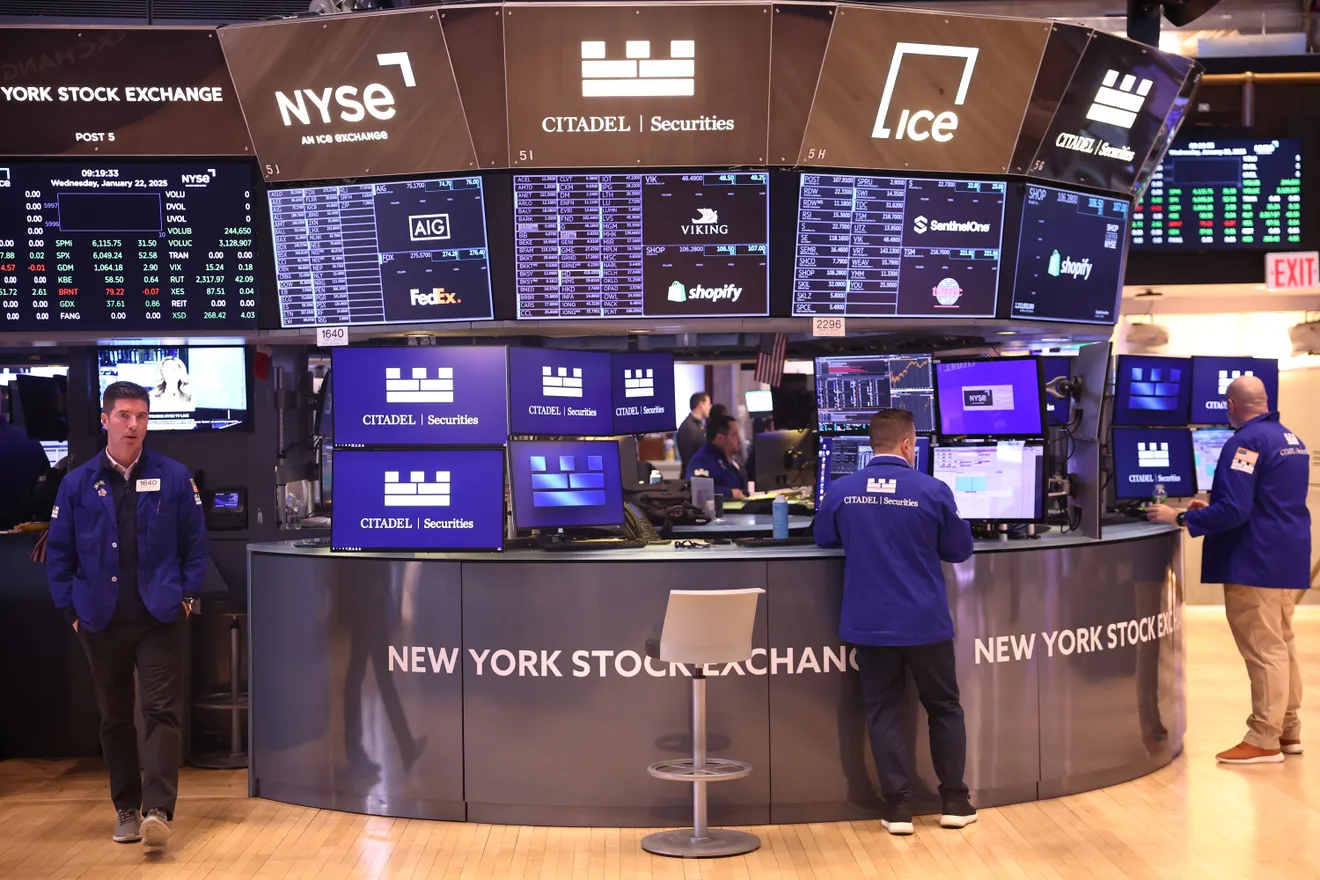
U.S. stocks opened the week higher but quickly turned red, struggling to recover some ground lost at the end of last week after weak economic data and looming tariff threats kept investors skittish.
A survey last week showed consumer are feeling more pessimistic, with inflation fears creeping up again amid President Donald Trump's constant threats of broad tariffs. Another economic report showed the services sector, which has been strong the past couple of years, fell into contractionary territory. All those worries pushed all three major U.S. stock indexes into the red last week, despite back-to-back record highs in the broad S&P 500 earlier in the week. The blue-chip Dow ended up posting the biggest weekly loss since October.
At 9:55 a.m. ET, the S&P 500 slipped 0.096%, or 5.76 points, to 6,007.37; the Dow inched up 0.097%, or 42.34 points, to 43,470.36 and the tech-heavy Nasdaq eased 0.43%, or 83.22 points, to 19,440.79. The benchmark 10-year Treasury yield fell to 4.418%.
Major events expected this week
Investors are likely biding time on Monday, setting up for a couple of major events this week. Among them, semiconductor darling Nvidia is due to report earnings after the market close on Wednesday. It'll be Nvidia's first earnings report since China's DeepSeek artificial intelligence model roiled the markets. Nvidia shares were last up 2%.
The DeepSeek AI model is supposed to rival its U.S. counterparts OpenAI and ChatGPT but built on a shoestring budget. That cast doubt on whether U.S. companies need to spend billions on AI and if they do, how they make back what they spent and more.
Aside from company news, investors also will focus on another inflation report due Friday. January's consumption expenditures index is due Friday morning and is the Federal Reserve's preferred inflation gauge to determine interest rate policy. Most economists have pared back expectations for rate cuts this year, with a growing number even saying the rate cutting cycle is over.
Corporate news
While investors wait for the main events later this week, they're looking at some of the morning's movers. They include:
- Domino’s Pizza shares fell nearly 6% after the pizza chain's earnings during the final few months of last year fell below analysts' forecasts.
- Microsoft stock dipped 1.42% after TD Cowen said in a report the software giant has begun canceling leases for a substantial amount of datacenter capacity in the U.S., which could reflect concerns about whether it’s building more AI computing than it will need over the long term. Earlier this year, Chinese upstart DeepSeek released a competitive open-source AI model at a fraction of the cost, which had for a time, many investors questioning whether U.S. companies' massive AI spending has been necessary. Microsoft denied any changes to its data center strategy, according to Jefferies analysts.
- Apple shares edged up fractionally after the company said it plans to spend more than $500 billion over the next four years to expand its manufacturing footprint in the U.S. Plans include hiring 20,000 workers and a new factory to produce servers supporting Apple Intelligence, the company’s generative-AI system.
Cryptocurrency
In a sign of easier regulation around cryptocurrency, Robinhood said the Securities and Exchange Commission dropped its investigation into the online trading platform's cryptocurrency unit with no intention of moving forward with an enforcement action.
However, Bitcoin was last down 1.2% at $95,144.04, still struggling to break out of a range with $100,000 holding at the top.
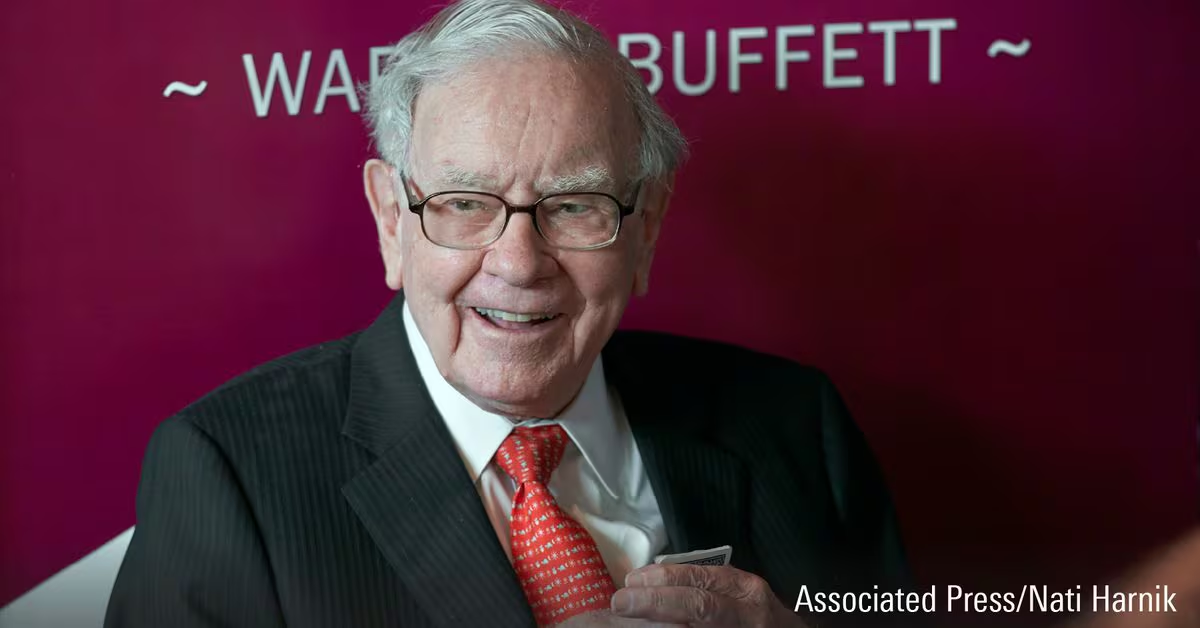
Warren Buffett’s Berkshire Hathaway BRK.A BRK.B has released its 13F for the fourth quarter of 2024. Here’s a look at the stocks that the team bought and sold during the fourth quarter and a few undervalued Warren Buffett stocks to buy from Berkshire Hathaway’s portfolio today.
Warren Buffett and his team initiated a position in one new stock last quarter: Constellation Brands STZ. The stock slumped in 2024 as consumers pulled back on alcoholic beverage spending; the stock is down 25% in 2025 after the company reported weak results. But with its portfolio of top-selling Mexican beer brands, including Corona and Modelo, we think the company has carved out a wide economic moat. The stock pullback has allowed Berkshire to pick up this high-quality company at what we consider to be an attractive price.
Berkshire also added to its positions in Domino’s Pizza DPZ and Pool Corp POOL, both of which were new additions to the portfolio in 2024’s third quarter. Buffett boosted Berkshire’s existing positions in Occidental Petroleum OXY, Verisign VRSN, and Sirius XM SIRI last quarter, too—and regulatory filings show that Berkshire has continued buying these three names in 2025, as well.
Berkshire began accumulating its current position in Oxy about three years ago and currently owns more than 28% of the company. Although Buffett has stated that Berkshire has no intent of buying the company outright, he did refer to Oxy in Berkshire’s shareholder letter last year as one of his “Rip Van Winkle” investments, suggesting that it’s a name Berkshire will own indefinitely. Berkshire likes the company’s vast oil and gas holdings in the United States and its leadership in carbon-capture initiatives.
Meanwhile, Berkshire has owned Verisign stock since 2012. Verisign is also a classic Buffett investment, as it maintains a monopoly position to register websites with .com and .net top-level domains with fixed pricing terms. Morningstar thinks the company has a wide economic moat.
Buffett hasn’t commented on Berkshire’s growing Sirius XM stake publicly as of this writing, even though Berkshire now owns well over a third of the company’s stock. Some may consider Sirius XM a monopoly in its own right, given that access to the service is standard in most new vehicles being sold today.
But Morningstar doesn’t think the company has an economic moat. “In our view, Sirius XM is fighting an uphill battle as the technology that once gave it a unique offering and an advantage over competition is no longer a necessity to offer a subscription service in vehicles,” says Morningstar senior analyst Matthew Dolgin. “We now see Sirius XM’s primary competition coming from streaming music providers that rely on internet connectivity rather than from terrestrial radio stations, and we believe those services provide the better value proposition for most consumers.”
That being said, Sirius XM does fit the mold as a blood-in-the-streets investment that Buffett could warm to: The stock was down 56% in 2024.
Berkshire continued to scale back its position in Bank of America during the fourth quarter—it began selling the bank’s shares in July last year. Berkshire’s now owns less than 10% of Bank of America, but the bank still remains among Berkshire’s holdings. It also sold nearly three fourths of its position in Citigroup C.
Berkshire also reduced its stake in several other names during the fourth quarter, including Capital One Financial COF, Charter Communications CHTR, Liberty Media Corp C Liberty Formula One FWONK, Louisiana Pacific LPX, NU Holdings NU and T-Mobile TMUS. Berkshire sold out of Ulta Beauty ULTA entirely after initiating the position in the second quarter of 2024.
4 Warren Buffett Stocks to Buy Now
Most of the publicly traded stocks held by Berkshire Hathaway are fairly valued or overvalued today, according to Morningstar’s metrics. Here are several of its holdings that look undervalued and most attractive according to Morningstar’s analysts.
Ally Financial ALLY
Constellation Brands
Kraft Heinz KHC
Occidental Petroleum
Here’s a little bit about why we like each of these stocks at these prices, along with some key metrics for each. All data is as of Feb. 14, 2025.
Ally Financial
Morningstar Rating: 4 stars
Morningstar Economic Moat Rating: None
Morningstar Capital Allocation Rating: Standard
Industry: Credit Services
Berkshire Hathaway owns more than 9% of Ally Financial’s stock. While Ally offers auto insurance, commercial lending, mortgage finance, and credit cards, auto loans remain its core focus and largest source of revenue. While a slower auto market and higher credit costs have weighed on recent results, Ally’s improved funding structure should lead to better returns than the firm has historically delivered. The stock trades 19% below our $46 fair value estimate.
Here’s what Morningstar analyst Michael Miller had to say about the stock after the company’s fourth-quarter earnings release:
Ally Financial reported solid earnings with adjusted EPS coming in at $0.78 versus $0.40 last year. This was largely due to lower operating and credit costs as total adjusted revenue only increased 3.6% over the same period. Ally also announced that it will be selling its credit card portfolio.
Why it matters: Ally appears to be turning a corner after a string of poor results in 2023 and 2024. The market is responding favorably to this shift, with the shares up around 4% on earnings.
Credit costs have been a major headwind for Ally recently, with the bank’s warning on future net charge-offs being responsible for a major correction in the shares last fall. However, the bank’s tighter underwriting is beginning to have an effect.
Credit costs are still higher than we would like, with auto net charge-offs rising to 2.34% of total loans from 2.21% last year. However, auto delinquency rates are showing better trends, and used car prices have stabilized, supporting the value of Ally’s collateral.
The bottom line: We maintain our $46 fair value estimate for no-moat Ally and view the shares as modestly undervalued as we believe the market is underestimating the firm’s long-term profitability.
We expect net charge-offs to begin to trend lower in the second half of 2025, though provisioning costs could decline sooner if the firm gains the confidence to release reserves.
We still have mixed feelings about the sale of Ally’s credit card business as it will reduce the long-term growth potential of the firm. That said, the move will likely improve Ally’s near- to medium-term performance.
Long view: We hold a positive long-term view of Ally’s earnings potential despite its recently unimpressive results. We expect the firm’s net interest margin to expand further as its loan book continues to roll off into new higher-yielding loans and the firm gets more aggressive on deposit rates.