Historical Memory and Modern Rivalry: China–Japan and Korea–Japan Tensions Over Time
Few relationships in East Asia are as layered and emotionally charged as those between China and Japan, and between Korea and Japan. These tensions are not merely diplomatic disagreements or economic rivalries; they are rooted in centuries of cultural exchange, imperial ambition, war, colonial rule, and contested historical memory. While China, Korea, and Japan today are major economic powers deeply intertwined through trade and regional institutions, unresolved grievances from the past continue to shape politics, public opinion, and security policy across Northeast Asia.
Understanding these tensions requires tracing their evolution from early cultural interaction through imperial expansion, world war, Cold War alignments, and into contemporary disputes over territory, history, and national identity.
Early Cultural Exchange and Shifting Power
Before modern nationalism took hold, China functioned as the dominant civilization in East Asia. Through the tributary system centered on imperial dynasties such as the Tang and Ming, China influenced both the Korean Peninsula and the Japanese archipelago culturally and politically. Writing systems, Confucian philosophy, Buddhism, and administrative models flowed from China to Korea and Japan.
The Korean kingdoms — particularly Goguryeo, Baekje, and Silla — and later the Joseon Dynasty maintained close diplomatic relations with China. Japan, during periods such as the Asuka and Nara eras, consciously adopted Chinese bureaucratic and legal systems. Yet Japan never became politically subordinate to China in the same way Korea often did through formal tributary ties.
Over time, Japan’s relative isolation during the Tokugawa shogunate (1603–1868) preserved domestic stability but left it vulnerable to Western pressure in the 19th century.
Meanwhile, Qing China struggled with internal rebellion and foreign encroachment. This reversal of fortunes set the stage for a dramatic shift in regional power dynamics.
Imperial Japan and the Sino-Japanese War
The modern roots of China–Japan tensions trace directly to the rise of imperial Japan following the Meiji Restoration in 1868. Rapid industrialization and military modernization transformed Japan into a regional power seeking expansion.
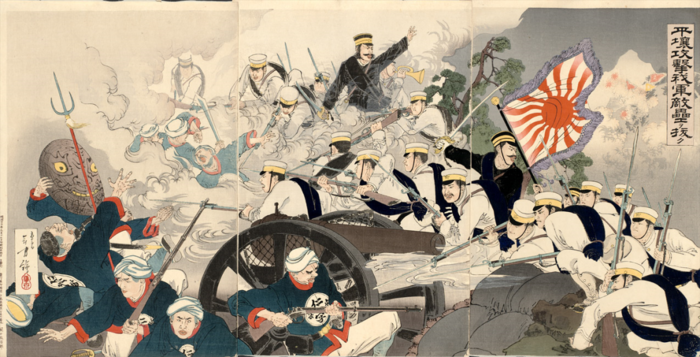
The First Sino-Japanese War (1894–1895) marked a decisive turning point. Fought primarily over influence in Korea, the war ended in a humiliating defeat for Qing China.
Under the Treaty of Shimonoseki, China ceded Taiwan and recognized Korean independence — effectively removing Korea from China’s sphere of influence and paving the way for Japanese domination.
The humiliation inflicted by Japan deeply scarred Chinese political consciousness. For Japan, victory validated its modernization project and emboldened imperial ambitions.
Tensions escalated further in the 1930s. In 1931, Japan invaded Manchuria and established the puppet state of Manchukuo. Full-scale war broke out in 1937 with the Second Sino-Japanese War, later folded into World War II.
Japanese forces committed widespread atrocities across occupied China. The most infamous was the Nanjing Massacre, during which hundreds of thousands of civilians and prisoners of war were killed.
The memory of wartime brutality remains central to Chinese national identity. The Chinese Communist Party has long emphasized resistance against Japanese aggression as foundational to modern China’s legitimacy. Consequently, historical disputes over textbooks, war memorials, and official apologies continue to inflame bilateral tensions.
Japan’s Colonization of Korea
While China endured invasion, Korea experienced full colonization. After defeating China and later Russia in the Russo-Japanese War (1904–1905), Japan consolidated control over the Korean Peninsula. In 1910, Japan formally annexed Korea, beginning 35 years of colonial rule.
Japanese administration brought industrialization and infrastructure development, but it was accompanied by severe repression. Korean language and cultural expression were suppressed. Land was expropriated, political dissent crushed, and many Koreans were conscripted into forced labor or military service.
Particularly contentious is the issue of “comfort women” — women and girls, many of them Korean, forced into sexual servitude for the Japanese military during World War II. The legacy of forced labor and sexual slavery continues to fuel diplomatic crises between Japan and South Korea.
Liberation came only with Japan’s defeat in 1945. However, the Korean Peninsula was soon divided into North and South, adding new geopolitical complexity to Korea–Japan relations.
Postwar Reconstruction and Cold War Alignments
After 1945, Japan came under U.S. occupation and was transformed into a pacifist state under a new constitution renouncing war. The United States quickly saw Japan as a critical ally against communist expansion.
China, by contrast, underwent revolution in 1949 with the establishment of the People’s Republic of China under Mao Zedong. Relations between Japan and China were effectively frozen for decades due to Cold War alignments, with Japan recognizing the Republic of China (Taiwan) until 1972.
Japan and South Korea normalized relations in 1965 through the Treaty on Basic Relations. Japan provided economic aid and loans, which contributed significantly to South Korea’s industrialization. However, many Koreans believed the treaty inadequately addressed colonial injustices, as compensation was directed to the South Korean government rather than individual victims.
Diplomatic normalization between Japan and the People’s Republic of China occurred in 1972. In 1978, the Treaty of Peace and Friendship established a framework for cooperation. Economic ties flourished rapidly, with Japan investing heavily in China’s modernization.
Yet historical memory remained unresolved beneath the surface.
History Textbooks and Symbolic Politics
From the 1980s onward, disputes over historical interpretation began to dominate China–Japan and Korea–Japan relations.
In Japan, conservative politicians and nationalist groups have sometimes sought to soften descriptions of wartime aggression in school textbooks. These revisions have drawn sharp criticism from both China and South Korea, who view them as attempts to whitewash history.
Visits by Japanese prime ministers to the Yasukuni Shrine — which commemorates Japan’s war dead, including convicted war criminals — have repeatedly triggered diplomatic protests. For China and Korea, such visits symbolize insufficient remorse for wartime atrocities.
Public opinion surveys frequently show mutual distrust. In China, anti-Japanese sentiment can surge during political disputes. In South Korea, perceptions of Japan are heavily influenced by unresolved colonial issues.
Territorial Disputes: Islands as Symbols
Territorial disputes have added a strategic dimension to historical tensions.
Between China and Japan, the focal point is the Senkaku Islands (called the Diaoyu Islands in China) in the East China Sea. Administered by Japan but claimed by China (and Taiwan), the islands are strategically located and potentially resource-rich.
Tensions intensified in 2012 when Japan nationalized several of the islands. China responded with regular coast guard patrols and military presence in surrounding waters. Air and naval encounters have become routine, raising concerns about accidental escalation.
Between Japan and South Korea, the dispute centers on the Dokdo Islands (known as Takeshima in Japan). South Korea administers the islets, but Japan maintains a claim. Although the dispute is smaller in military terms than the Senkaku/Diaoyu issue, it carries enormous symbolic weight, particularly in Korea where Dokdo is seen as a symbol of resistance against Japanese colonialism.
Economic Interdependence and Strategic Competition
Despite political tensions, economic ties between China and Japan have been vast. China has been Japan’s largest trading partner for years, and Japanese companies have played key roles in China’s industrial supply chains.
However, competition has intensified. China’s rapid military modernization and assertive foreign policy under Xi Jinping have raised concerns in Tokyo. Japan has strengthened its alliance with the United States and expanded defense cooperation with countries such as Australia and India.
In 2023, Japan announced plans to significantly increase defense spending, marking a departure from decades of restrained military posture. China criticized these moves as evidence of Japanese remilitarization.
Meanwhile, relations between South Korea and Japan have fluctuated. Trade disputes erupted in 2019 when Japan imposed export controls on semiconductor materials amid disagreements over forced labor compensation rulings by South Korea’s Supreme Court. South Korea responded with boycotts of Japanese goods.
Diplomatic efforts in the early 2020s sought to repair ties, recognizing shared concerns over North Korea’s nuclear program and regional security. Yet underlying historical grievances remain potent.
The Role of National Identity and Memory
At the heart of these tensions lies historical memory and national identity.
In China, narratives of the “Century of Humiliation” — which includes Japanese invasion — are central to patriotic education. Remembrance of wartime suffering reinforces a sense of unity and vigilance against foreign aggression.
In South Korea, colonial rule is deeply embedded in national consciousness. Movements for democracy and independence during Japanese occupation are celebrated as defining moments in Korean history.
In Japan, memory is more fragmented. While many Japanese acknowledge wartime wrongdoing, others emphasize Japan’s postwar pacifism and contributions to regional development. Generational divides are evident, with younger Japanese sometimes feeling detached from events of the 1930s and 1940s.
Political leaders in all three countries must navigate domestic pressures shaped by these narratives.
Contemporary Security Concerns
Today’s tensions are influenced not only by history but also by shifting power balances.
China’s rise as a global power challenges Japan’s regional position. Maritime disputes intersect with broader U.S.–China rivalry, placing Japan at the center of strategic competition.
South Korea’s relationship with Japan is complicated by North Korea’s nuclear threat. Intelligence-sharing agreements between Seoul and Tokyo are strategically important but politically sensitive.
Trilateral cooperation among the United States, Japan, and South Korea has increased in response to North Korean missile tests and China’s growing influence. However, public opinion in South Korea can constrain how far such cooperation goes.
Prospects for Reconciliation
Efforts at reconciliation have occurred periodically. Joint historical commissions, diplomatic apologies, compensation funds, and summit meetings have attempted to address grievances.
Some Japanese leaders have issued formal apologies for wartime actions. South Korean and Chinese leaders have occasionally acknowledged Japan’s postwar pacifism and economic contributions. Civil society exchanges, tourism, and youth programs have fostered people-to-people connections.
Yet reconciliation remains incomplete. Each new controversy — whether a textbook revision, shrine visit, court ruling, or island incident — can reignite old wounds.
The challenge lies in balancing acknowledgment of historical injustice with forward-looking cooperation in an increasingly uncertain geopolitical environment.
Conclusion
The tensions between China and Japan, and between Korea and Japan, are products of layered history: cultural exchange, imperial conquest, war atrocities, colonial rule, Cold War politics, territorial disputes, and evolving power balances.
Economic interdependence has not erased historical memory. Strategic necessity has not eliminated mistrust.
Instead, the relationships are characterized by a paradox: deep integration alongside deep suspicion.
As East Asia continues to shape the global economy and security landscape, how these nations manage their historical grievances will profoundly influence regional stability. The past remains present in Northeast Asia — not as a distant memory, but as a living force shaping diplomacy, identity, and the future trajectory of the region.
 4044
4044