
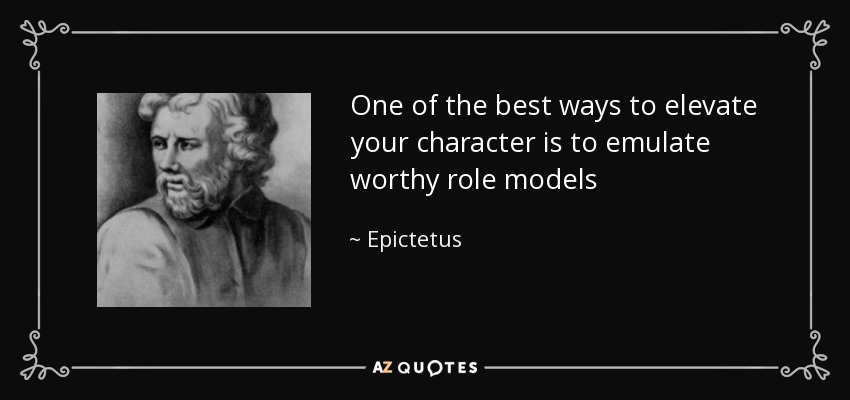
There's Power In Emulation, But Eventually You Must Define YOU!
From childhood, we are taught—sometimes explicitly, often silently—to look up to those who have achieved greatness. We admire the business mogul who built an empire from a garage, the investor who multiplied modest savings into billions, the athlete who shattered records, the scholar who changed the intellectual landscape, and even the cultural icon whose style shaped generations. Emulation becomes one of the earliest and most powerful tools of human development.
We study, imitate, model, and mirror. It is how we learn to speak, to think, to dream.
But while emulation can be a powerful catalyst, it can also become a cage.
The journey of personal growth often begins by walking in someone else’s footsteps—but it must not end there.
The Power of Emulation
Imitation is not weakness; it is wiring. Humans are social learners. Before innovation comes observation. Before originality comes absorption.
In business, countless entrepreneurs have studied the playbooks of leaders like Bill Gates, analyzing how he built Microsoft into a global powerhouse. In investing, many have patterned their strategies after Warren Buffett, adopting value-investing principles and long-term discipline. In sports, young basketball players once mirrored the footwork and fadeaway of Michael Jordan.
In education, scholars model their thinking after great thinkers. In style, entire generations borrow from fashion icons.
There is undeniable wisdom in studying excellence.
Emulation shortens the learning curve. Instead of wandering blindly, you begin with a roadmap. You gain access to tested principles, mental frameworks, and proven strategies. You avoid certain mistakes because someone else already made them. You learn patterns of success faster than if you had to invent everything from scratch.
In this way, emulation is apprenticeship.
Even in the tech world, where innovation reigns supreme, founders have studied predecessors. Mark Zuckerberg famously admired Gates in his early years.
As he built Facebook (now Meta), there were parallels in ambition, technical intensity, and the desire to scale rapidly. But admiration was only the beginning of his story—not the conclusion.
Because emulation has limits.
When Emulation Becomes Imitation Without Identity
There is a fine line between learning from someone and losing yourself in them.
Too much emulation can suppress originality. When every decision is filtered through “What would they do?” you risk silencing the deeper question: “What is uniquely mine to do?”
If a young entrepreneur tries to replicate Gates’ exact strategies in today’s economy, they are not operating in 1975. The technological landscape, venture capital ecosystem, regulatory climate, consumer behavior, and competitive intensity have radically transformed. The personal computer revolution was once untapped territory. Today’s frontier might be artificial intelligence, biotechnology, decentralized finance, or something not yet named.
Exact replication ignores context.
Similarly, an investor who attempts to mirror Buffett’s early trades without understanding the specific market inefficiencies of the 1950s and 1960s may find diminished results. The informational advantage Buffett once had—when financial data was slower to circulate—cannot be duplicated in the age of algorithmic trading and instant digital access.
The same holds true in sports. An athlete modeling their entire game on Michael Jordan may forget that Jordan’s success was not merely about fadeaways and footwork—it was about competitive psychology, era-specific defensive rules, coaching structures, and team dynamics that cannot be perfectly reproduced.
When you emulate someone, you are often copying the visible surface of their success while missing the invisible foundations.
And those invisible foundations matter.
The Hidden Variables of Success
One of the greatest misconceptions about success is that it is linear and transferable. We see the highlight reel but not the hundreds of subtle variables that shaped the outcome.
Consider childhood influences. Family environment. Economic conditions. Educational exposure. Early mentors. Geographic location. Historical timing. Social networks. Cultural movements. Personality traits. Random luck.
When someone attempts to fully replicate another’s path, they only see fragments of the full equation.
You might read every biography, watch every interview, analyze every speech—but you will never fully inhabit the inner psychology of the person you admire. You cannot experience the exact same mentors who shaped their thinking. You cannot relive the societal conditions that created their opportunities. You cannot replicate the micro-decisions they made at age twelve, fifteen, or twenty that subtly steered their trajectory.
What you are emulating is a story already edited by hindsight.
And herein lies the danger: believing that duplicating observable behaviors will automatically yield identical outcomes.
The world changes. Markets evolve. Industries mature.
Culture shifts. Technology accelerates. What worked once may no longer work—or may require adaptation.
The Advantages of Strategic Emulation
This does not mean we should abandon emulation entirely. In fact, strategic emulation remains one of the most effective ways to accelerate growth.
There are powerful benefits:
1. Skill acquisition – Modeling the mechanics of excellence builds competence.
2. Mental frameworks – Learning how great thinkers structure decisions sharpens judgment.
3. Confidence through precedent – Seeing that something has been done expands belief in what is possible.
4. Standards of excellence – Emulating high performers raises your internal bar.
The key word is strategic.
Emulation works best when it is principle-based rather than personality-based. Instead of copying the exact behavior of a billionaire CEO, study the underlying habits: long-term thinking, discipline, adaptability, resilience, curiosity.
Instead of dressing exactly like a style icon, learn why their style works—fit, proportion, authenticity, context.
Instead of duplicating a sports legend’s moves, internalize their work ethic and mental toughness.
When you extract principles rather than personalities, you retain room for your uniqueness.
The Psychological Risk: Living in Another Person’s Shadow
Over-emulation can create psychological dependency.
You begin to measure your progress not by your own standards but by someone else’s timeline. If they became a millionaire at 30, you feel behind at 31. If they launched a company at 22, you feel late at 25. If they won championships by 28, you question your potential at 29.
Comparison distorts perspective.
Everyone’s starting line is different. Everyone’s path curves differently. Some bloom early. Others bloom late. Some take detours that become defining advantages later in life.
Living in someone else’s shadow can also suppress risk-taking. You may avoid experimenting outside the blueprint because deviation feels unsafe. But innovation rarely emerges from rigid imitation.
The irony is that many of the people we admire became great precisely because they deviated from what was conventional.
When the Training Wheels Must Come Off
Returning to Zuckerberg and Gates, the early admiration did not result in permanent imitation. Eventually, Zuckerberg had to make decisions that were uniquely suited to his era: social networking dominance, mobile-first strategy, global connectivity at unprecedented scale.
He could not simply recreate Microsoft’s path. The internet age demanded different instincts.
This pattern appears repeatedly across history. Many leaders begin as students of greatness but ultimately surpass imitation.
In sports, young players once studied Jordan, but they had to adapt to a three-point-heavy league and new analytics-driven systems. In business, founders may study Microsoft but must navigate cloud computing, artificial intelligence, and globalized competition. In investing, disciples of Buffett often evolve their strategies to reflect new market dynamics.
The training wheels of emulation are valuable—but only temporarily.
At a certain stage, continued reliance on someone else’s blueprint becomes limiting. You must integrate what you’ve learned and step into uncertainty.
You must take creative risks.
You must trust your instincts.
You must blaze your own path.
The Courage to Diverge
Blazing your own path does not mean rejecting mentorship or ignoring wisdom. It means synthesizing what you’ve absorbed and applying it through your own lens.
This is the turning point in every journey toward greatness.
You stop asking, “How can I be them?” and start asking, “What can I build with what I’ve learned?”
This shift is subtle but transformative.
Instead of chasing duplication, you pursue differentiation.
Instead of recreating someone else’s mountain, you discover your own terrain.
And here’s the deeper truth: society advances not through replicas, but through reinterpretations.
If every entrepreneur perfectly copied Gates, innovation would stall. If every investor strictly mirrored Buffett, markets would stagnate. If every athlete mimicked Jordan, the game would never evolve.
Progress depends on adaptation.
Integrating Emulation and Originality
The healthiest approach to emulation follows three stages:
Stage 1: Absorb.
Study those you admire. Learn their habits, discipline, mindset, and mistakes. Build foundational skills.
Stage 2: Adapt.
Translate those lessons into your own context. Consider how today’s environment differs. Modify strategies to match your strengths and circumstances.
Stage 3: Create.
Move beyond imitation. Develop your own voice, systems, and innovations. Take ownership of your decisions and outcomes.
This progression transforms admiration into mastery.
It allows you to honor your heroes without becoming imprisoned by them.
Your True Greatness
Perhaps the greatest danger of excessive emulation is that it can hide your own untapped brilliance.
When you are too focused on replicating someone else’s strengths, you may overlook your own natural advantages. The world does not need another copy of a tech mogul, investor, athlete, or influencer. It needs individuals who combine wisdom from the past with vision for the future.
Your personality, upbringing, insights, struggles, and timing create a combination that has never existed before.
No amount of imitation can replicate that.
Yes, learn from greatness. Yes, study excellence. Yes, admire success.
But remember that those you admire once faced the same crossroads you face now: follow the familiar path or venture into uncertainty.
They chose uncertainty.
And eventually, you must too.
Because at some point, the most courageous act is not copying brilliance—but trusting that you carry your own.
 8572
8572