
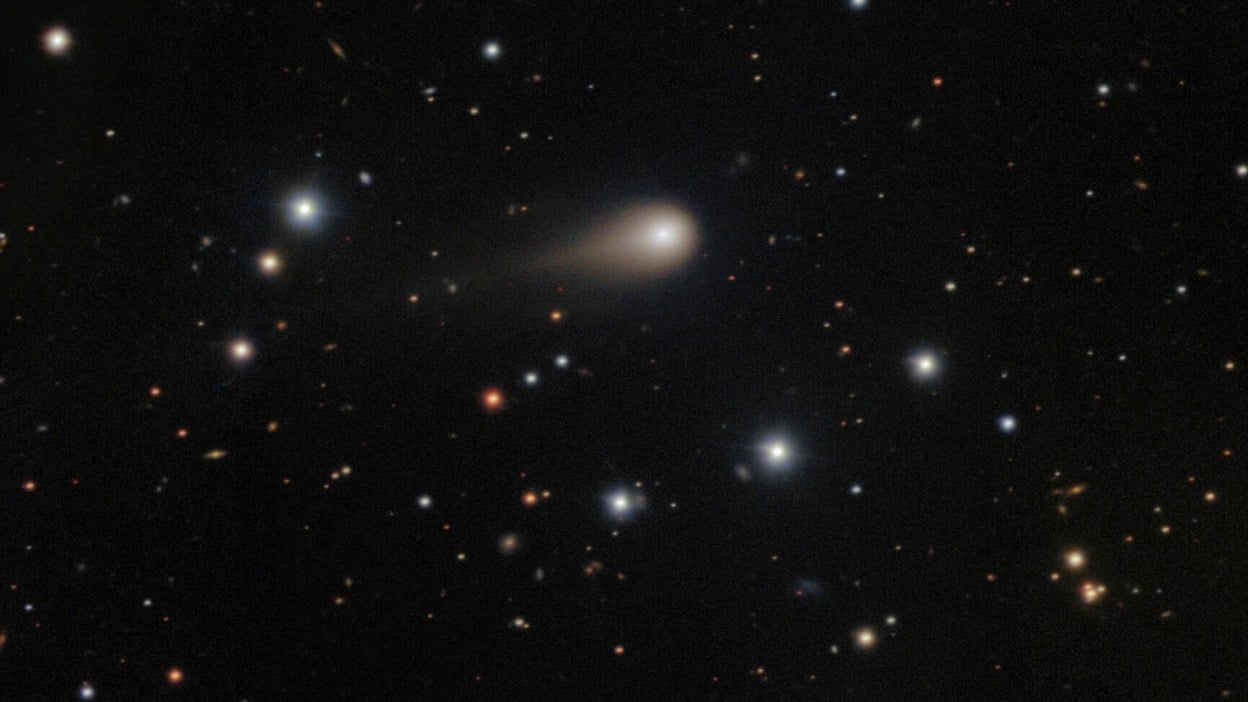
Interstellar comet keeps its distance as it makes its closest approach to Earth
An interstellar visitor once again reminds humanity of the vastness and dynamism of our cosmic neighborhood. Comet 3I/ATLAS, a rare object from beyond our solar system, is making its closest approach to Earth this week — albeit at a comfortably distant margin that poses no threat to the planet.
Discovered on July 1, 2025, by NASA’s ATLAS survey telescope in Chile,
3I/ATLAS is only the third confirmed interstellar object ever detected passing through our solar system, following ‘Oumuamua in 2017 and 2I/Borisov in 2019. Its highly hyperbolic orbit shows that it came from outside our solar system, journeying across interstellar space for perhaps millions or even billions of years before its current visit.
A Close But Safe Encounter
The comet’s closest approach to Earth is expected around December 19, 2025, when it will still be more than 167 million miles (269 million kilometers) away — nearly twice the distance between Earth and the Sun. Scientists stress that while this is the comet’s nearest point to our planet in its outbound trajectory, it remains far enough to be harmless.
Though faint and invisible to the unaided eye, 3I/ATLAS can be tracked through telescopes and binoculars by dedicated amateur astronomers. Observatories worldwide have been capturing its motion and changing appearance in the night sky.
Scientific Interest & International Effort
Astronomers and space agencies are treating this rare flyby as an exceptional scientific opportunity. Instruments including NASA’s Hubble Space Telescope, ground-based facilities like the Gemini North telescope, and even interplanetary missions are contributing to a coordinated observation campaign. The U.N.’s International Asteroid Warning Network (IAWN) has been involved in tracking and sharing data about the comet’s position and behavior.
Notably, recent telescope images show the comet developing a striking green glow as it nears the Sun’s influence. This vibrant color comes from gases such as diatomic carbon (C?) being released from the comet’s icy nucleus and fluorescing when exposed to sunlight — a reminder of the dynamic chemistry at play even on objects from distant star systems.
What 3I/ATLAS Can Teach Us
Interstellar comets like 3I/ATLAS offer researchers rare glimpses into the building blocks and environmental conditions of other star systems. By studying its composition, tail structure, and outgassing behavior, scientists can compare these materials with comets native to our own solar system. These comparisons may yield clues about how planets and small bodies form in diverse stellar environments.
After sweeping past Earth’s neighborhood, the comet is expected to continue outward, eventually heading back into interstellar space and beyond. While it won’t return, its visit provides a once-in-a-lifetime chance to deepen humanity’s understanding of our place in the galaxy.
 8651
8651