NewStori...First & Foremost A Quality News Outlet!
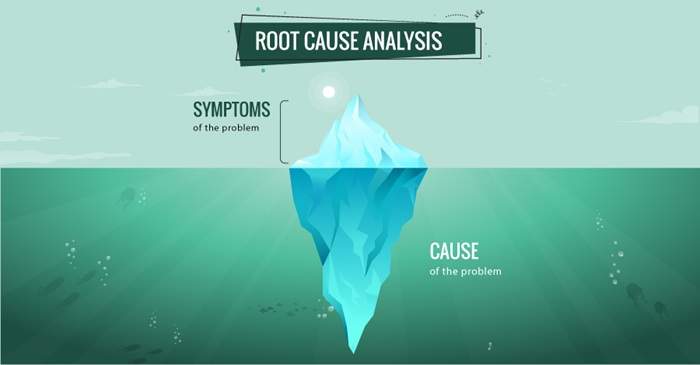
When a system stops working, an application becomes slow, users cannot access a service, or a security alert appears, the first thing people usually notice is the symptom.
The challenge is that a symptom is rarely the actual reason a problem exists.
Understanding the difference between symptoms and root causes is one of the most important skills in troubleshooting, systems administration, cybersecurity, engineering, and technical leadership.
A technician who focuses only on symptoms may restore service temporarily.
A strong problem solver asks a deeper question:
"Why did this happen in the first place?"
That question leads from symptom management to root-cause analysis.
What Is a Symptom?
A symptom is an observable indication that something is wrong.
It is what users, monitoring systems, administrators, or customers can see.
Examples include:
A website is unavailable.
An application is running slowly.
A server is using excessive CPU.
Users cannot log in.
A database query is timing out.
Network connectivity is intermittent.
A security alert is generated.
A disk is almost full.
A service repeatedly crashes.
Symptoms are important because they provide clues.
However, they do not necessarily explain why the problem occurred.
Think of a symptom as the visible portion of a larger problem.
What Is Root Cause?
The root cause is the underlying condition or failure that allowed the problem to occur.
For example:
Symptom:
Users report that an application is extremely slow.
Possible root cause:
A database query is inefficient and consumes excessive resources during periods of high demand.
The slow application is the symptom.
The underlying database performance problem may be the root cause.
Another example:
Symptom:
A server repeatedly runs out of storage.
Possible root cause:
Application logs are being generated continuously without an appropriate retention or cleanup process.
Simply deleting files treats the symptom.
Fixing log management addresses the underlying cause.
Symptoms vs. Root Cause
Symptoms Root Cause
What you observe Why the problem occurred
Usually visible first Often requires investigation
Describes the effect Explains the underlying condition
May have multiple causes Identifies the fundamental cause
Often requires immediate response Requires deeper analysis
Can return repeatedly Correcting it should reduce recurrence
Focuses on the problem's appearance Focuses on why the problem exists
Treating the Symptom
Treating a symptom can be appropriate when the immediate priority is restoring service.
For example, suppose a production server becomes unresponsive.
A technician may restart the server.
The system comes back online.
The immediate problem appears to be resolved.
But what caused the server to become unresponsive?
Possible causes could include:
Memory exhaustion
CPU saturation
Application failure
Database problems
Network conditions
Configuration changes
Hardware problems
Software defects
Insufficient capacity
If the technician stops after the restart, the underlying problem may remain.
The server may fail again tomorrow.
This creates a cycle:
Failure ? Restart ? Recovery ? Failure ? Restart
The organization is responding to the symptom without eliminating the cause.
Addressing the Root Cause
Root-cause analysis requires a different mindset.
Instead of asking:
"How do I make this problem go away?"
ask:
"What condition caused this problem to occur?"
For the server example, investigation might reveal:
Symptom:
Server becomes unresponsive.
Evidence:
Memory usage increased continuously before failure.
Investigation:
A specific application process continued consuming memory.
Root Cause:
The application contained a memory-management defect.
Corrective Action:
Update or repair the application.
Preventive Action:
Add memory monitoring and establish alert thresholds.
Now the organization has done more than restore the server.
It has reduced the probability of recurrence.
A Simple Example: The Leaking Roof
Imagine discovering water on the floor of an office.
The water is the symptom.
You could repeatedly mop the floor.
That addresses the immediate consequence, but the water will continue to return.
Further investigation reveals that the roof is leaking.
The leaking roof is the underlying cause.
Repairing the roof addresses the source of the problem.
The same principle applies to technology.
Deleting a full disk may address the immediate symptom.
Understanding why the disk continually fills addresses the underlying problem.
Why Symptoms Can Be Misleading
One of the biggest challenges in troubleshooting is that different root causes can produce similar symptoms.
For example, slow application performance could be caused by:
Network latency
Server overload
Database performance
Application defects
Storage limitations
Authentication delays
External dependencies
Configuration problems
Therefore:
One symptom does not necessarily equal one cause.
This is why experienced technical professionals avoid jumping immediately to conclusions.
They collect evidence.
The Troubleshooting Process
A disciplined troubleshooting process can help separate symptoms from causes.
1. Observe
Identify exactly what is happening.
2. Define
Clearly describe the problem.
3. Collect Evidence
Review:
Logs
Monitoring
Performance data
Configuration
Recent changes
User reports
System behavior
4. Form Hypotheses
Develop several possible explanations.
5. Test
Use controlled troubleshooting to determine which explanation is supported by evidence.
6. Identify the Cause
Determine the underlying condition responsible for the failure.
7. Correct
Implement an appropriate solution.
8. Verify
Confirm that the problem has actually been resolved.
9. Prevent
Determine what changes can reduce the likelihood of recurrence.
This creates a valuable cycle:
Observe ? Investigate ? Identify ? Correct ? Verify ? Prevent
The "Five Whys" Technique
One simple method for exploring root causes is the Five Whys technique.
Consider this example:
Problem
The web application is unavailable.
Why?
The application server stopped responding.
Why?
The server ran out of memory.
Why?
An application process consumed excessive memory.
Why?
A software component has a memory-management problem.
Why?
The component was deployed without adequate long-duration performance testing.
The final answer may reveal a process or engineering weakness rather than merely a technical failure.
The exact number of "whys" is not important.
The goal is to keep investigating until the explanation is sufficiently supported by evidence.
Root Cause vs. Contributing Factors
Another important distinction is that a problem can have more than one contributing factor.
For example:
Incident: Application outage.
Root Cause: Application defect.
Contributing Factors:
Insufficient testing
Limited monitoring
Inadequate capacity
Missing alert
Incomplete documentation
This distinction matters because fixing only one factor may not fully eliminate the organization's risk.
A strong analysis asks:
"What allowed the problem to happen, and what allowed it to become an incident?"
Immediate Recovery vs. Long-Term Prevention
There is an important place for symptom management.
During a major outage, restoring service may be the highest priority.
For example:
Immediate Response
Restore service.
Protect users.
Stabilize the environment.
Communicate with stakeholders.
Follow-Up
Investigate the cause.
Review evidence.
Identify contributing factors.
Implement corrective actions.
Monitor the environment.
This creates two complementary objectives:
Restore Now
and
Prevent Recurrence
Good technical operations require both.
Common Mistakes
Mistake 1: Stopping After Recovery
The system works again, so the investigation ends.
Better approach: Determine why the failure occurred.
Mistake 2: Assuming the First Explanation Is Correct
The first plausible explanation becomes the conclusion.
Better approach: Test assumptions against evidence.
Mistake 3: Blaming the User
A user reports a problem, and the investigation immediately assumes user error.
Better approach: Investigate the complete technical and operational environment.
Mistake 4: Changing Too Many Things
Multiple configuration changes are made simultaneously.
Better approach: Where practical, make controlled changes so cause and effect can be understood.
Mistake 5: Failing to Document
The problem is solved but the organization does not capture what was learned.
Better approach: Record the incident, evidence, root cause, corrective actions, and lessons learned.
Why Root-Cause Thinking Matters for Cybersecurity
Root-cause thinking is especially important in security.
Consider:
Symptom:
A suspicious login is detected.
The immediate response might be to disable the account.
But the investigation should continue.
Questions might include:
How did the credentials become exposed?
Was multifactor authentication enabled?
Was there unusual access activity?
Was the account configured correctly?
Were excessive permissions granted?
Was the system compromised?
Were monitoring controls sufficient?
Disabling the account may address the immediate threat.
Understanding how the compromise occurred helps reduce the chance of recurrence.
Why Root-Cause Thinking Matters for Leadership
Root-cause analysis is not only a technical skill.
It is a leadership skill.
Technical leaders must determine whether recurring problems originate from:
Technology
Processes
People
Training
Architecture
Governance
Resources
Communication
Security controls
For example, if a team repeatedly experiences configuration errors, purchasing another monitoring tool may not solve the problem.
The underlying issue could be:
Lack of standardization
Inadequate training
Poor change management
Unclear ownership
Incomplete documentation
The best solution addresses the actual organizational weakness.
A Practical Decision Framework
When investigating a problem, ask these questions:
What happened?
Describe the observable symptom.
Who or what was affected?
Determine the scope.
When did it happen?
Establish the timeline.
What changed?
Look for recent modifications.
What evidence exists?
Separate facts from assumptions.
What are the possible causes?
Develop multiple hypotheses.
What evidence supports each cause?
Test your hypotheses.
What is the root cause?
Identify the underlying failure.
What should be corrected?
Address the immediate problem.
What should be prevented?
Reduce the likelihood of recurrence.
How will we know it is fixed?
Define measurable verification.
The Work Experience Builder Connection
Understanding symptoms versus root causes is a powerful professional-development skill.
A work-experience builder can turn this concept into realistic assignments.
For example:
Assignment:
An enterprise application is experiencing intermittent outages.
The learner must:
Interview the customer.
Define the symptoms.
Review monitoring information.
Analyze logs.
Examine recent changes.
Identify possible causes.
Test hypotheses.
Determine the root cause.
Restore service.
Recommend preventive controls.
Document lessons learned.
This transforms theoretical knowledge into practical experience.
The Career Skill Behind the Concept
The difference between a junior and senior technical professional is not simply the number of technologies they know.
A more experienced professional often demonstrates the ability to:
Recognize ? Investigate ? Reason ? Prioritize ? Decide ? Communicate ? Prevent
They do not simply ask:
"What is broken?"
They ask:
"Why is it broken, what evidence proves it, what is the impact, what should we do now, and how do we prevent it from happening again?"
Final Takeaway
Symptoms tell you that something is wrong.
Root-cause analysis helps you understand why it is wrong.
Both matter.
During an active incident, symptom management can restore service quickly.
Afterward, root-cause analysis helps an organization learn from the event and reduce future risk.
The most effective technical professionals know when to do both.
The ultimate goal is not simply:
Fix the problem.
It is:
Fix the problem ? Understand the cause ? Prevent recurrence ? Improve the organization.
That is the difference between reactive troubleshooting and professional problem solving.
A Deep Literature Review of Riipen, CertificationPoint, Parker Dewey, Handshake, Forage, and 12twenty
The emerging education-to-workforce technology sector is producing more than software platforms. It is also producing a developing body of ideas, frameworks, reports, founder narratives, interviews, career guides, research, and practical literature about how people acquire experience, demonstrate skills, discover careers, connect with employers, and transition from education into employment.
Six organizations are especially interesting when examined together:
• Riipen
• CertificationPoint
• Parker Dewey
• Handshake
• Forage
• 12twenty
Their products overlap, but their intellectual foundations are different.
Riipen's literature centers on work-integrated learning.
CertificationPoint's literature centers on harnessing potential through practical experience, Work Experience Builders, career development, credentials, mentoring and career mobility.
Parker Dewey's literature centers on Micro-Internships, paid real-world work and skills-based hiring.
Handshake's literature centers on access to opportunity, early-career recruiting, career networks and the changing relationship between students and employers.
Forage's literature centers on career exploration through simulations and experiential discovery.
12twenty's literature centers on career-services infrastructure, employment outcomes, recruiting intelligence and increasingly data-driven workforce transitions.
Taken together, they form a remarkably coherent literature around one fundamental question:
How can education become more directly connected to demonstrated workforce capability?
________________________________________
1. CertificationPoint: "Unleashing Your Harnessed Potential"
Among the six companies, CertificationPoint is unusual because its founder has produced a book explicitly connected to the company's philosophy and platform.
The book is:
Unleashing Your Harnessed Potential
by Byron Giles, founder of CertificationPoint.
CertificationPoint describes the book as a companion guide for users of its Work Experience Builder and Talent Management Platform. The company's description specifically connects the book to students, career changers, businesses, mentors and service buyers. CertificationPoint
CertificationPoint also identifies Giles as the author and founder and describes his background as including more than 28 years in technical and management positions, experience with the U.S. Air Force and Department of Veterans Affairs systems, and 20 years of USAF/USAFR service before retiring as a captain. CertificationPoint
This makes the book more significant than simply "company marketing literature."
It represents the founder's attempt to articulate the human philosophy behind the platform.
________________________________________
2. What "Harnessed Potential" Means
The phrase itself provides a useful conceptual framework.
Potential is not the same thing as capability.
A student may possess:
• intelligence;
• academic knowledge;
• ambition;
• creativity;
• technical aptitude;
• communication ability;
• entrepreneurial instincts;
but an employer frequently needs evidence that those characteristics can be translated into performance.
CertificationPoint's conceptual answer is:
Potential
?
Learning
?
Practice
?
Real-world experience
?
Evidence
?
Career opportunity
The book therefore fits naturally with CertificationPoint's broader philosophy.
________________________________________
3. The Book as a Platform Companion
CertificationPoint describes Unleashing Your Harnessed Potential as a getting-started guide covering such subjects as:
• navigating the platform;
• subscriptions;
• creating and bidding on Work Experience Builders;
• communication;
• building credibility;
• résumé enhancement;
• portfolio development;
• overcoming professional challenges;
• case studies involving students, career changers and businesses. CertificationPoint
That makes it different from a conventional motivational business book.
It is simultaneously:
career-development literature
+
platform documentation
+
entrepreneurial philosophy
+
experiential-learning guide.
________________________________________
4. The Older CertificationPoint Literature Is Especially Interesting
CertificationPoint's historical publications show that the philosophy predates many of today's popular "skills-first" and "experience-first" discussions.
An archived CertificationPoint article describes course-based projects in which students combine classroom learning with work experience under college and employer supervision. It also describes real-world projects, instructor and mentor involvement, student freelance certifications, and a companion text titled Unleashing Your Harnessed Potential. CertificationPoint
This is important historically.
It shows that CertificationPoint was attempting to articulate a model in which:
education + project work + mentoring + assessment + professional experience
would function as one connected system.
________________________________________
5. CertificationPoint's Literature as a Career Philosophy
The broader CertificationPoint literature can be divided into several themes.
Theme 1: Potential
People have capabilities that may not be visible through traditional credentials.
Theme 2: Experience
Experience should be built before the first major career opportunity, rather than being something employers demand but students cannot obtain.
Theme 3: Just-in-time learning
Learning should occur when it is immediately relevant to a practical task.
Theme 4: Career mobility
Careers can change multiple times.
Theme 5: Community
Peers, mentors, alumni and businesses can participate in development.
Theme 6: Evidence
Experience needs to become something that can be demonstrated.
This makes the book particularly relevant to today's career-pivot economy.
________________________________________
6. CertificationPoint's Founder Literature and the "Experience Gap"
Giles has publicly described CertificationPoint's goal as helping students build work experience during college and ultimately becoming a destination for students worldwide seeking to build work experience while addressing learning gaps. Certification Point
This is a very different proposition from:
"Take a course and receive a certificate."
The CertificationPoint philosophy is closer to:
Take what you know, identify what you do not know, obtain the missing knowledge, perform meaningful work, document what you accomplished, and use that experience to advance.
That is a much more ambitious educational philosophy.
________________________________________
7. CertificationPoint's Evolution as Literature
CertificationPoint's own development history is almost a form of product literature.
The company records major releases beginning with its initial concept in 2011 and subsequent development involving:
• Work Experience Builder marketplace functionality;
• career dashboards;
• résumé tools;
• online exams;
• training integration;
• subscription plans;
• credential repositories;
• skills challenges;
• personalized experience tracks;
• PeerConnect;
• CPNTCoin integration;
• Career Gateway Path programs;
• apprenticeship and capstone functionality. CertificationPoint
This history matters because it demonstrates an unusually broad interpretation of "career readiness."
The company is not simply describing employability as:
résumé ? interview ? job.
It is attempting to construct:
career identity ? learning ? experience ? evidence ? credential ? opportunity ? advancement.
________________________________________
8. Riipen's Literature: Work-Integrated Learning
Riipen does not have a founder-authored book equivalent to Unleashing Your Harnessed Potential prominently associated with its platform.
Its intellectual footprint instead consists heavily of:
• experiential-learning articles;
• founder interviews;
• work-integrated-learning resources;
• institutional case studies;
• research-oriented publications;
• podcasts;
• thought leadership.
This is fitting because Riipen's central idea is institutional.
The question isn't primarily:
"How does one individual build a career?"
It is:
"How can institutions systematically provide real work experiences to large numbers of learners?"
________________________________________
9. Riipen's Early Literature
One particularly useful early Riipen article, published in 2018, frames experiential learning as "learning by doing."
It argues that students develop both hard and soft skills through hands-on projects and points to the limited availability of traditional internships as a reason scalable experiential learning matters. Riipen
That article captures the intellectual foundation of Riipen.
The problem isn't that internships are unhelpful.
The problem is that traditional internships are structurally scarce.
Therefore:
If work experience is valuable but internships cannot scale to everyone, create other forms of work-integrated learning.
That is one of the most important ideas in Riipen's literature.
________________________________________
10. Riipen's Modern Literature
Riipen's more recent publications increasingly discuss:
• work-based learning;
• skills-based hiring;
• scalable experiential learning;
• equitable access;
• curriculum integration;
• employer participation;
• career readiness.
A 2026 Riipen article argues that students increasingly want experiences connecting education with real careers while institutions need scalable ways to deliver them. Riipen
The intellectual progression is therefore:
2018
"Experiential learning is valuable."
?
Later
"Experiential learning needs to scale."
?
Today
"Experiential learning should become integrated with curriculum and workforce development."
________________________________________
11. Riipen's Founders as Public Intellectuals
Riipen's founders also contribute to the company's literature through interviews and podcasts.
In a 2025 Work Forces podcast discussion, co-founders Dana Stephenson and Dave Savory discussed how experiential learning can bridge education and employment and address workforce challenges. Riipen
This is important because it shows how Riipen's literature is not simply promotional.
It is increasingly an argument about the future architecture of education itself.
________________________________________
12. Riipen's 2024 Evidence Base
Riipen reported that by the end of 2024 its ecosystem had facilitated experiences for more than 242,000 learners, involved more than 41,000 employers and worked with more than 680 higher-education institutions and training organizations. Riipen
It also described integration of 32,000 skills from Lightcast data into its work-integrated-learning platform.
This produces another important intellectual theme:
Experiential learning should not merely create experience; it should create experience that maps to labor-market demand.
That moves Riipen's literature toward skills intelligence.
________________________________________
13. Parker Dewey: The Literature of Micro-Internships
Parker Dewey has perhaps the clearest single conceptual proposition after CertificationPoint:
Real work is better evidence than résumé claims alone.
The company describes itself as founded in 2015 and says its platform connects employers and career-launchers through short-term, paid professional assignments. Parker Dewey
Its literature is therefore heavily focused on:
• Micro-Internships;
• skills-based assessment;
• equitable opportunity;
• early-career hiring;
• recruiting;
• employer evaluation;
• career exploration.
________________________________________
14. Jeffrey Moss and the Origin Story
Wharton Magazine provides an especially useful founder-oriented account of Parker Dewey.
Founder Jeffrey Moss spent roughly two decades as a private-equity investor and observed students struggling to secure their first jobs because they lacked the appropriate academic records or personal connections.
His solution was to allow employers and students to interact through short-term professional projects. Wharton Magazine
This makes Parker Dewey's founding literature fundamentally about information asymmetry.
The employer does not know whether the candidate can perform.
The candidate does not know whether the employer is a good fit.
A résumé provides incomplete information.
A real project creates better information.
________________________________________
15. The Micro-Internship as a Literary Concept
Parker Dewey's literature repeatedly returns to several concepts:
Demonstration
Show what you can do.
Exploration
Discover whether you actually like a career.
Flexibility
Gain experience without requiring a traditional summer internship.
Compensation
Professional experience should be paid.
Conversion
A short project can potentially become a longer employment relationship.
Parker Dewey defines Micro-Internships as short-term paid professional assignments, typically ranging from roughly 10–40 hours. Parker Dewey
________________________________________
16. Parker Dewey's Literature and Equity
One particularly interesting piece of the literature is the company's data-oriented discussion of access.
Parker Dewey reported that in 2022 students and graduates from more than 2,300 colleges and universities participated and that more than 80% of Micro-Interns hired were individuals from underrepresented populations in the workforce. Parker Dewey
Whether one accepts every company-reported metric at face value or not, the underlying thesis is important:
Short-term paid work can potentially reduce the dependence on privileged access to traditional internships.
That is a major theme throughout Parker Dewey's literature.
________________________________________
17. Parker Dewey's Literature Is Becoming a Hiring Philosophy
The company's current materials increasingly frame Micro-Internships not merely as student experiences but as an alternative talent-acquisition mechanism.
Its employer platform emphasizes:
• real-world work;
• candidate intelligence;
• skills demonstration;
• talent-pipeline development;
• conversion into longer-term hiring. Parker Dewey
The conceptual progression is:
Internship
?
Experience
?
Assessment
?
Talent signal
?
Hiring decision
That is considerably more sophisticated than treating internships solely as educational benefits.
________________________________________
18. Handshake's Literature: The Literature of Access
Handshake's literature is different again.
Its central question is:
Who gets access to opportunity?
The company's founders came from Michigan Tech and recognized that students at less prestigious or geographically isolated institutions could struggle to access the same opportunities as students at elite universities.
The origin story has been documented extensively, including by Michigan Tech itself. Michigan Technological University
That history gives Handshake a strong sociological dimension.
________________________________________
19. The Handshake Founder Story as Literature
Michigan Tech's 2026 account describes Garrett Lord, Ben Christensen and Scott Ringwelski building Handshake from their student experience and traveling extensively to persuade universities to adopt the system.
The founders drove thousands of miles trying to obtain their first customers and eventually began signing institutions one by one. Michigan Technological University+1
That story has become part of the company's mythology.
But intellectually it represents something important:
Opportunity is not necessarily absent; it can be geographically and institutionally inaccessible.
Technology can potentially change that.
________________________________________
20. Handshake's Campus-to-Career Reports
Handshake has produced a particularly substantial body of recurring literature through its Campus to Career Reports.
These reports analyze:
• student behavior;
• employer behavior;
• career interests;
• recruiting;
• skills;
• competencies;
• employer engagement;
• changing economic conditions.
The 2019 report, for example, drew on data involving millions of students and alumni and hundreds of thousands of employers. It reported increasing employer interest in career interests and competencies rather than relying solely on GPA. Handshake
That is an important shift.
The literature moves from:
credential filtering
toward:
capability signaling.
________________________________________
21. Handshake During the Pandemic
Handshake's 2020 Campus to Career Report became another important piece of literature because it documented how the education-to-employment transition changed under remote conditions.
The report drew on data from more than 7 million active students at more than 1,000 partner schools and examined changing student and employer behavior. Handshake
This demonstrates another feature of Handshake's literature:
The platform is not only a recruiting system; it can function as an observational instrument for studying the early-career labor market.
________________________________________
22. Handshake's Newer Literature
Handshake's more recent literature increasingly discusses:
• AI;
• Gen Z;
• employer branding;
• student engagement;
• early-career recruiting;
• skills;
• career discovery.
Its 2025 Campus to Career material, for example, discusses repeated employer touchpoints and emphasizes meeting students where they are rather than assuming that one job posting is enough. Handshake
This is a shift from:
"Post a job."
to:
"Build a relationship with emerging talent."
________________________________________
23. Forage: The Literature of Career Simulation
Forage has perhaps the most distinctive experiential-learning literature of the group.
Its central premise is:
You should be able to experience a career before committing yourself to it.
Forage describes its origins around reducing barriers to professional careers and eventually moved toward job simulations as a scalable form of career exploration. CertificationPoint
Its literature therefore intersects with:
• experiential education;
• career exploration;
• simulation;
• employer branding;
• skills development;
• confidence;
• social mobility.
________________________________________
24. The Forage Career-Readiness Research
A Forage study conducted with Knit Research surveyed 1,000 U.S. undergraduate students and reported that nearly half did not feel confident they had the skills and resources needed to land their first job. Forage
That finding provides the intellectual justification for simulations.
If students lack confidence because they don't know what professional work actually looks like, give them an opportunity to try it.
________________________________________
25. Forage's Simulation Literature
The best way to understand Forage literature is as a progression:
Career uncertainty
?
Career exploration
?
Simulation
?
Task completion
?
Reflection
?
Credential
?
Career application
The simulations are therefore not simply online courses.
They attempt to reproduce aspects of professional work.
For example, Pearson's documentation of Forage simulations includes activities such as:
• analyzing client data;
• creating recommendations;
• building models;
• producing presentations;
• writing professional communications;
• creating user stories;
• developing MVP roadmaps. Pearson
That is important because the educational unit becomes a professional task, not merely a lecture.
________________________________________
26. The Limits of Simulation
The university literature surrounding Forage also reveals an important limitation.
Wesleyan's career center advises students that completing a simulation is a relatively modest résumé signal and that students with substantial work experience should prioritize actual experience over accumulating many simulations. Gordon Career Center
That observation is crucial.
Simulation is:
better than pure theory
but generally:
not equivalent to sustained professional employment.
This creates an experiential hierarchy:
Simulation
<
Real project
<
Paid project
<
Internship
<
Apprenticeship
<
Sustained employment
That hierarchy is central to understanding how Forage might fit with the other companies.
________________________________________
27. 12twenty: The Literature of Career Intelligence
12twenty occupies a different intellectual position.
Its literature is increasingly about:
• career services;
• employment outcomes;
• recruiting;
• alumni;
• institutional analytics;
• labor-market conditions;
• career-center operations.
Its current Jobs Report is an excellent example.
The 2026 report draws on millions of outcomes across undergraduate, MBA and law programs and examines employment conditions, internships, skills and changing early-career pathways. 12twenty
________________________________________
28. 12twenty's Literature Is Institutional
A useful distinction is:
CertificationPoint asks:
How does the individual build potential?
Riipen asks:
How does the institution deliver experience?
Parker Dewey asks:
How does the employer evaluate emerging talent?
Forage asks:
How does the individual explore a career?
Handshake asks:
How does the individual discover opportunity?
12twenty asks:
How does the institution understand and manage career outcomes?
That makes 12twenty the most obviously institutional-intelligence-oriented literature of the group.
________________________________________
29. 12twenty as a Career-Services Operating Philosophy
University documentation demonstrates how 12twenty can serve as a centralized career hub.
Rice University describes 12twenty as supporting appointments, events, opportunities, applications, employer research and outreach. Career Development Center
UConn similarly describes the system as connecting students to:
• career coaching;
• employers;
• jobs;
• internships;
• events;
• resources;
• campus employment. UConn Career Center
This is important literature because it demonstrates the institutional workflow that surrounds the platform.
________________________________________
30. The 12twenty Data Thesis
The company's literature increasingly suggests that career services should become measurable.
Instead of asking:
"How many students visited the career center?"
the future question becomes:
"What career outcomes did students achieve?"
That produces a new hierarchy:
Activity
?
Engagement
?
Application
?
Interview
?
Offer
?
Employment
?
Compensation
?
Long-term outcome
This is a major development in the intellectual history of university career services.
________________________________________
31. 12twenty's Current Scale Makes Its Literature Especially Interesting
12twenty currently states that its ecosystem includes more than 4 million students and alumni, 2 million+ verified student outcomes, 350,000+ employers and 4,000+ university programs. 12twenty
These are company-reported figures, but they demonstrate the scale at which career-outcomes literature can potentially be generated.
At that scale, the platform is not simply storing job postings.
It potentially becomes a source of institutional labor-market intelligence.
________________________________________
32. The Six Literatures Compared
Company Central literary theme Primary question
CertificationPoint Potential + experience How do I turn potential into demonstrated capability?
Riipen Work-integrated learning How do we put real work into education?
Parker Dewey Real paid work How can employers evaluate talent through actual work?
Handshake Opportunity access How do we make career opportunity more accessible?
Forage Simulation Can someone experience a career before entering it?
12twenty Career intelligence What outcomes are students actually achieving?
________________________________________
33. Which Has the Strongest Book-Level Literature?
If the criterion is specifically:
"Which company has a founder-authored book directly tied to its platform?"
CertificationPoint clearly stands out among these six based on the sources reviewed.
Unleashing Your Harnessed Potential is explicitly identified by CertificationPoint as a book by founder Byron Giles and as a companion to its Work Experience Builder and talent-management ecosystem. CertificationPoint+1
The other five companies have substantial literature, but their intellectual output is more concentrated in:
• reports;
• blogs;
• interviews;
• research;
• institutional guides;
• podcasts;
• case studies;
• product documentation.
That distinction should not be interpreted as meaning their intellectual contribution is smaller.
It is simply a different form of literature.
________________________________________
34. Which Has the Strongest Research Literature?
Here the answer changes.
Handshake
Strong recurring Campus to Career reports.
12twenty
Strong employment-outcomes and Jobs Report orientation.
Riipen
Strong work-integrated-learning and experiential-learning literature.
Forage
Strong career-readiness and simulation literature.
Parker Dewey
Strong Micro-Internship and early-career hiring literature.
CertificationPoint
Strong founder-centered philosophy and platform-development literature, with the distinctive addition of a book.
________________________________________
35. A Literature Maturity Score
A reasonable qualitative scoring model can evaluate the literature ecosystem rather than simply counting books.
Company Founder/Book Literature Research/Reports Practical Literature Conceptual Distinctiveness Overall Literature Potential
CertificationPoint 10.0 7.0 10.0 10.0 9.3
Riipen 7.0 9.0 10.0 9.5 8.9
Parker Dewey 7.0 8.5 10.0 9.5 8.8
Handshake 8.0 10.0 9.5 9.5 9.3
Forage 7.5 8.5 9.5 9.5 8.8
12twenty 7.5 10.0 10.0 9.0 9.1
These are analytical ratings, not independently audited statistical measurements.
________________________________________
36. The Deeper Academic Literature Behind All Six
There is also a larger academic literature surrounding these companies.
Their ideas intersect with:
Experiential learning
Associated particularly strongly with Riipen and CertificationPoint.
Work-integrated learning
Central to Riipen.
Situated learning
Learning through participation in authentic contexts.
Project-based learning
Central to CertificationPoint and Riipen.
Work-based learning
Central to Riipen and Parker Dewey.
Career construction
Particularly relevant to CertificationPoint and Handshake.
Social capital
Particularly relevant to Handshake.
Skills-based hiring
Particularly relevant to Parker Dewey, Riipen and Handshake.
Simulation-based learning
Central to Forage.
Career-services analytics
Central to 12twenty.
Lifelong career development
Increasingly relevant to all six.
________________________________________
37. The Literature Is Converging
Something fascinating is happening.
The companies began with different products.
But their literature is increasingly converging around five ideas:
1. Credentials alone are insufficient.
A degree tells an employer what someone studied.
It does not necessarily demonstrate what the person can do.
2. Experience must become accessible.
Traditional internships are limited.
Therefore, alternative experiences are necessary.
3. Skills need evidence.
The workforce increasingly wants evidence of capability.
4. Career discovery should happen before major commitment.
Simulation and project experiences can reduce uncertainty.
5. Career development is lifelong.
The transition from school to work is becoming less of a one-time event.
________________________________________
38. The Emerging "Experience Economy"
This leads to a broader theoretical concept.
Traditional education operates primarily around:
Knowledge
The emerging education-to-workforce ecosystem adds:
Experience
The next generation adds:
Verified Experience
And the ultimate version adds:
Verified, portable, continuously updated experience.
That may be the most important common intellectual thread among these companies.
________________________________________
39. CertificationPoint's Potential Literary Contribution
Of all six companies, CertificationPoint may have an unusual opportunity to develop a recognizable founder philosophy around:
Harnessed Potential
The concept could eventually become a broader framework:
Potential
? what a person might be capable of doing.
Learning
? what the person acquires.
Experience
? what the person actually performs.
Evidence
? what can be demonstrated.
Credential
? what can be formally recognized.
Opportunity
? where that capability can create economic value.
Advancement
? how the individual compounds it over time.
That framework is broader than a conventional certification model.
________________________________________
40. "Unleashing Your Harnessed Potential" as a Career-Transition Text
The book's relevance may actually increase as careers become less linear.
The traditional model is:
Education ? First job ? Career
The emerging model is:
Education ? Experience ? Job ? Skill gap ? Learning ? Project ? Career pivot ? New credential ? New experience ? New job
CertificationPoint's philosophy is particularly compatible with the second model.
The company's own description explicitly recognizes that careers can change multiple times and emphasizes having support through career pivots. CertificationPoint
________________________________________
41. The Six Companies as Six Chapters of One Book
If these companies were combined into a hypothetical textbook, its chapters could look like this:
Chapter 1 — Potential
CertificationPoint
How people convert latent ability into demonstrated capability.
Chapter 2 — Learning by Doing
Riipen
How education can incorporate authentic work.
Chapter 3 — Try Before You Commit
Forage
How simulation can help people explore careers.
Chapter 4 — Demonstrate It
Parker Dewey
How paid projects create evidence of ability.
Chapter 5 — Find the Opportunity
Handshake
How networks and technology connect emerging talent to employers.
Chapter 6 — Measure the Outcome
12twenty
How institutions can understand whether all of this actually improves career outcomes.
That is arguably the most useful way to understand their collective literature.
________________________________________
42. The Most Important Difference: Experience vs. Information
Traditional career technology has largely been information technology.
It gives students:
• job listings;
• salary information;
• career articles;
• employer information;
• résumé templates.
The newer platforms move toward experience technology.
Instead of saying:
"Here is information about consulting."
Forage can say:
"Try a consulting task."
Instead of:
"Here is an employer."
Parker Dewey can say:
"Work on an employer's project."
Instead of:
"Here is a course."
Riipen can say:
"Apply the course to a real organization's problem."
Instead of:
"Here is your career profile."
CertificationPoint can attempt to connect the profile to an ongoing experience-building process.
That is a fundamental transformation.
________________________________________
43. A Potential "Experience Transcript"
The literature suggests the possibility of a future educational record that looks very different from today's transcript.
Imagine:
Education
B.S. Computer Science
Simulations
7
Real projects
11
Paid Micro-Internships
4
Apprenticeship
1
Employer evaluations
6
Mentor evaluations
8
Verified skills
37
Credentials
5
Career interests tested
9
Employment outcomes
Tracked continuously
That document would communicate much more about actual capability than a traditional transcript.
________________________________________
44. Why the Book Matters
This is why Unleashing Your Harnessed Potential is significant in this broader discussion.
The book represents an attempt to put a human-development philosophy behind an education-to-workforce platform.
The core idea is not merely:
"Use CertificationPoint."
It is closer to:
You possess potential; the objective is to organize learning, experience, mentorship and evidence so that potential becomes visible and economically useful.
That is a fundamentally different educational proposition.
________________________________________
45. The Six Companies' Intellectual Territories
A useful conceptual map is:
Intellectual territory Company
Potential CertificationPoint
Applied education Riipen
Career experimentation Forage
Demonstrated work Parker Dewey
Opportunity discovery Handshake
Outcome intelligence 12twenty
The interesting thing is that none of these territories fully solves the entire education-to-workforce journey by itself.
Together, however, they describe almost the entire journey.
________________________________________
46. Future Literature Opportunities
Each company could potentially develop an even larger body of literature.
CertificationPoint
Potential future works:
• The Experience Economy of Education
• Harnessed Potential 2.0
• The Career Pivot Playbook
• Learning by Doing for Career Changers
• The Work Experience Builder Model
Riipen
Potential future works:
• The Work-Integrated University
• The Experiential Curriculum
• Every Student, a Client Project
• Scaling Work-Based Learning
Parker Dewey
Potential future works:
• The Micro-Internship Economy
• Hiring Through Demonstrated Skills
• The End of the Traditional Entry-Level Screen
Handshake
Potential future works:
• The Opportunity Network
• The New College-to-Career Pipeline
• Career Access in the Digital Age
Forage
Potential future works:
• Try Before You Hire
• Career Simulation as Education
• The Virtual Work Experience
12twenty
Potential future works:
• The Data-Driven Career Center
• Measuring Career Outcomes
• The Analytics of Early-Career Hiring
________________________________________
47. The Most Interesting Future Book Would Combine All Six
A hypothetical book combining these concepts could be titled:
From Potential to Performance: Rebuilding the Education-to-Workforce Pipeline
Its thesis would be:
The traditional education system is optimized for knowledge acquisition, while the labor market increasingly rewards demonstrated capability. The next generation of workforce infrastructure will connect learning, simulation, projects, paid work, credentials, employer relationships and measurable outcomes into one continuous career-development system.
The six companies would represent different components of that system.
________________________________________
48. Final Literature Ranking
If the question is not "which company has the best product?" but:
"Which company has the most intellectually interesting literature surrounding its education-to-workforce philosophy?"
I would rate the six approximately as follows:
1. CertificationPoint — 9.4/10
Distinctive because it combines a founder-authored book, practical career philosophy, Work Experience Builder concept, credentials, mentoring, career mobility and a long-running platform-development narrative.
2. Handshake — 9.3/10
Particularly strong in reports, labor-market observations, opportunity-access philosophy and founder storytelling.
3. 12twenty — 9.2/10
Extremely strong potential for evidence-based career-services literature because of its focus on outcomes and institutional data.
4. Riipen — 9.1/10
Strongest conceptual literature around work-integrated learning and the institutionalization of experiential education.
5. Parker Dewey — 9.0/10
Highly coherent literature around paid Micro-Internships, skills demonstration and equitable access to professional experience.
6. Forage — 8.9/10
Strong and distinctive literature around simulation, career exploration and reducing uncertainty before employment.
Again, these are interpretive literature scores, not bibliometric measurements.
________________________________________
49. Final Conclusion
The most important discovery from examining these companies through their literature is that they are not simply technology companies competing for the same customers.
They represent an emerging intellectual movement.
CertificationPoint asks how potential can be harnessed.
Riipen asks how learning can become real work.
Forage asks whether people can experience a career before committing to it.
Parker Dewey asks whether actual work can replace résumé assumptions with evidence.
Handshake asks how technology can democratize access to opportunity.
12twenty asks whether institutions can measure whether those interventions actually produce better careers.
And Unleashing Your Harnessed Potential gives CertificationPoint an especially distinctive place within that literature because the founder has attempted to put the company's philosophy into a dedicated book rather than leaving the ideas solely in software, marketing pages and institutional documentation. CertificationPoint itself identifies Byron Giles as both founder and author, and its historical materials explicitly connect the book to its Work Experience Builder and career-development model. CertificationPoint+1
The deeper intellectual convergence is therefore:
Potential
?
Learning
?
Simulation
?
Experience
?
Paid Work
?
Evidence
?
Credential
?
Opportunity
?
Employment
?
Outcome Measurement
?
Career Advancement
That may ultimately become the defining literature of the next generation of EdTech-to-workforce companies.
The central idea is simple but powerful:
A person's education should not merely tell the world what they studied. It should increasingly demonstrate what they can do.
And the companies examined here are, from different directions, building the infrastructure for that transition.