NewStori...First & Foremost A Quality News Outlet!
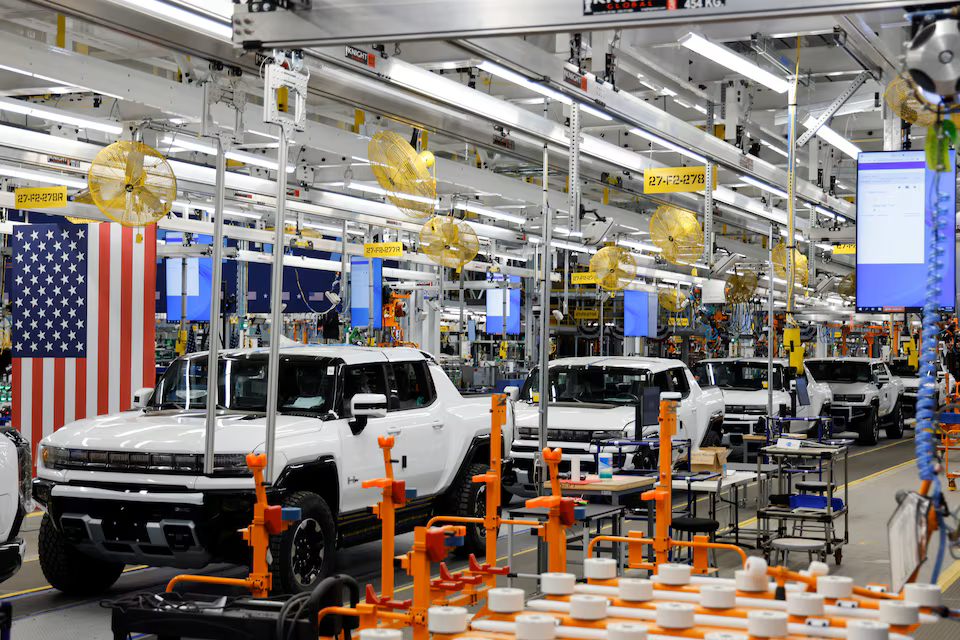
General Motors said on Thursday it would take a $6 billion charge to unwind some electric-vehicle investments, the latest car company to pull back from EVs in response to the Trump administration's policies and fading demand.
General Motors (GM.N), opens new tab said on Thursday it would take a $6 billion charge to unwind some electric-vehicle investments, the latest car company to pull back from EVs in response to the Trump administration's policies and fading demand.
The charge stems from reducing its planned EV production and the fallout on the supply chain, GM said in a regulatory filing, and comes weeks after rival Ford Motor (F.N), opens new tab announced a similar but much bigger charge.
Most of GM's writedown - a $4.2 billion cash charge - is related to contract cancellations and settlements with suppliers, who had planned for much higher production volumes before the market turned.
GM said the writedown would not affect its U.S. lineup of roughly a dozen EV models, which is the industry’s broadest offering of battery-powered vehicles. “We plan to continue to make these models available to consumers,” it said in its filing.
The company will record the charge as a special item in its fourth-quarter earnings report. It expects to incur additional charges in 2026 as a result of negotiations with its supply base, but expects them to be less than its 2025 EV charges.
Shares fell 2% in after-hours trading. They ended the regular session on Thursday up 3.9% at $85.13.
GM PLACED A BIG BET ON EVs
Many automakers, including GM’s crosstown rival, Ford, have been dialing back factory work on EVs since last summer, when U.S. President Donald Trump’s massive tax and spending package darkened the outlook for the EV market. Sales of battery-powered vehicles have cratered following the elimination on September 30 of a $7,500 federal tax credit for EV buyers.
Ford in December said it would take a $19.5 billion writedown over several quarters as it canceled several EV programs, including the fully electric version of its F-150 Lightning truck and an additional electric truck and van.
GM, the largest U.S. automaker by sales, made one of the biggest bets on EVs among global automakers, at one point vowing to essentially phase out internal-combustion cars and trucks by 2035.
While the company has not publicly walked back the 2035 goal, analysts have sharply cut the industry’s EV sales forecast into the next decade for the U.S., GM’s largest and most profitable market. GM CEO Mary Barra has said the company will respond to customer demand.
GM’s EV sales had started gaining traction in late 2024 after years of manufacturing setbacks. The company rolled out more lower-cost offerings, helping it reach No. 2 in sales behind Tesla (TSLA.O), opens new tab.
The company also said on Thursday that it would record a $1.1 billion charge in the fourth quarter related to its ongoing restructuring of its China joint venture.
The automaker began writing down some EV-related investments last year, including a $1.6 billion third-quarter charge. This month, GM halted production of EV batteries at two joint-venture plants for six months and cut production to one shift at an EV-only factory in Detroit.
The company also pivoted away from plans for another Michigan factory that was slated to build EVs, and instead will build the Cadillac Escalade and full-size pickups, it has said.
GM gained U.S. market share in 2025 on the strength of its gas-powered large pickups and SUVs, and its EVs, but some analysts have questioned the automaker's decision to focus on fully electric vehicles instead of hybrids.
"GM’s lack of hybrid exposure could partially reverse recent market share gains," CFRA equity analyst Garrett Nelson said in a research note on Thursday, citing the surging popularity of hybrid vehicles.
EV SALES ARE DOWN INDUSTRYWIDE
GM’s EV sales dropped 43% in the fourth quarter after the loss of the consumer tax credit. Sales hit record highs in the previous three months, when customers rushed to buy EVs before the credit ended.
EV sales across the industry increased 1.2% in 2025 from the previous year, according to research firm Omdia, a much slower growth rate than previous years.
Automotive data provider Edmunds expects EVs to account for about 6% of overall U.S. vehicle sales in 2026, down from 7.4% in 2025.
Ford’s shift, in which it essentially killed off its entire planned second generation of EVs, resulted in a much higher charge. Ford CEO Jim Farley said it was a painful but necessary move as the market cooled.
“When the market really changed over the last couple of months, that was really the impetus for us to make the call,” Farley told Reuters in a December interview.
Ford is now setting its EV hopes on a brand-new architecture that will enable the production of affordable models, starting with a $30,000 electric pickup in 2027.

In today’s digital-first business environment, identity is the new perimeter. As organizations embrace cloud platforms, hybrid IT environments, and remote work, ensuring that the right people have the right access at the right time has never been more critical. Identity and Access Management (IAM) is the cornerstone of secure business transformation, enabling organizations to protect sensitive resources while empowering employees, partners, and customers.
What is Identity & Access Management?
Identity & Access Management (IAM) refers to the policies, processes, and technologies that ensure digital identities are verified, managed, and granted access appropriately. IAM governs who can access which resources, under what circumstances, and with what privileges.
Key components of IAM include: